Thursday, May 28, 2009

Officially the Funniest Thing I've Seen in Weeks


Fortunately for me, Movementpants is choreographing Opera Cabal's brand new Vesalii Icones (by Peter Maxwell Davies, 1969) this summer. Get ready, Chicago.

Wednesday, May 13, 2009

Cliff Notes Carmen at COT

It's no use pretending. Peter Brook is a genius, but there's no Peter Brook in the recent La tragédie de Carmen at Chicago Opera Theater. In fact, last night's production proved a long unsubstantiated theory of mine that Peter Brook's younger brother, also somewhat unimaginatively named Peter Brook, wrote La tragédie and passed it off as the work of his older brother, hoping to ruin the poor man's career. How else to explain a canned version of Carmen that seems programmed to put people to sleep? If you sit back and close your eyes, which I'd advise you to do if you go to the final performance tomorrow, you might even hallucinate that you never left home ... drifting off in ye old armchair listening to "Renee Fleming: Great Opera Scenes," the iPod shuffle randomly selects "Carmen: Hottest Hits" and away you go ....

There were two moments of potential greatness in the production, when I thought or maybe just hallucinated I was dealing with the real Mr. Brook.

Hallucination no. 1: About 20 minutes into the opera, Carmen has already sung three arias back to back, and it starts to seem like something might be wrong. She finishes one and then, whoa, it's another aria from Carmen! And another! But then I thought, ah, yes, how clever (here's where the hallucination begins) ... the insinuation is that Carmen is literally a singing fool. She has to keep looping the same arias endlessly because the forward motion of the opera depends upon the enchantment her voice produces. The minute she stops, everything spirals out of control and her hot-headed lovers start killing each other. This theory of mine also (brilliantly!) explains why Carmen would fall for the slightly metro Escamillo instead of Marlboro Man José. Why? Because Escamillo is also a singing machine. Obviously! The girl who belts out the Habanera has to go home with the guy who sings "Tor-e-a-dor en ga-ha-ha-harde!" They're made for each other (until they run through their entire playlist and then discover they don't actually know one another ... no, wait, that would be the Sondheim Carmen). José's problem, like Eminem in 8 Mile, is that he can never get up the guts to sing in public and then when he does, it's just not very catchy. His only good aria comes too little too late, and Carmen's offstage anyway so she misses most of it. Oh, no ... I'm coming out of my reverie and ... it's a terribly choreographed fight scene! Aack!

Hallucination no. 2: I thought I detected a little prank, directed at the ultimate 19th-century tragic opera cliché -- the way the audience always knows what's going to happen, but the characters never catch on until it's too late. The same conceit drives scary movies. (We think: don't open the door, for chrissake! Don't answer the phone! Stop! He's got a knife! But of course the door is opened, the phone is answered, everybody dies.) It works the same way with opera. Except that the last scene of Carmen violates the rule. In the final duet, José plays the hapless lover who still believes he can make things work. Carmen is the dejected ex-lover who thinks it'll never work.... but then, suddenly, Carmen looks out at the audience ... she seems to know how the opera will end ... she's stepping outside the operatic frame! Carmen is half audience, half Carmen! She knows how it's going to end, but she still has to play out the scene. But José, poor boy, he's still trapped inside the tragic spiral. Their dialogue becomes strangely disordered. He says he isn't going to kill her. She says just do it! He says he loves her, they should go. She says, hey man, will you just drop it? José gets angry and kills her but not because he wants to. He kills her because she threatened suspension of belief, because Carmen was about to kill the very premise of opera itself! Oh, no ... the man behind me just snorted at Garcia's totally hilarious fake death.

I know, I know. The ravings of a madwoman. None of these things happened. But really, now, I'm trying to be funny, because I'm sad. I tried, I really tried, watching this production, to find a reason to like it. Actually, there's one reason: no intermission.

Saturday, May 2, 2009

Office Space Opera

I witnessed an understudy performance of Clemenza di Tito yesterday afternoon, behind the Harris Theater mainstage. It was produced by the various assistants (to the conductor, the director, even the rehearsal pianist) who get together with the understudies to the main roles, and in the space of one week develop their own reading of the opera. But there are caveats. The performance lasts one hour, instead of two and a half. And there's no stage, no backstage, and no lighting. The performance happened in a kind of dance/conference room with space enough for about twenty people, two upright pianos, a handful of chairs, classroom track lighting, a trashcan, a clock, bad ventilation, and a couple exit signs. In other words, a lot like the last place on earth you'd wanna sing an opera. Unless you're Peter Sellars. (His infamous Marriage of Figaro, set in New York City's Trump Towers, substituted an uncomfortable opera-in-your-dorm-room kind of thing for the stop-everything-and-just-sing decor typical of a [say, 1998] Met production of the opera.)

R.B. Schlather, who assisted Christopher Alden on the set for Tito, did a good job of using what he had, i.e. next to nothing, rather than fighting it. Characters who were supposed to be offstage either sat lifeless at the long conference table planted in the center of the room, or huddled in the weird, dark exit corridor at the back. Rabihah Davis sang Vitellia's last aria (which maybe ought to have been sung from inside the corridor) slouched against the long dance mirror stage left, playing with her reflection. It was a nice effect, since Vitellia at this point literally retreats into a world of her own. Other characters, with no recourse to escape heady dramatic confrontations, occasionally turned face-first into the wall and remained there in an abrupt gesture of total helplessness.

The scenes that worked against the anti-operatic qualities of the room were less successful. In the finale, Sesto is about to be condemned to death and he/she simply walked up to the table and laid down on it. It would have made more sense, given the space, if he had been condemned to a paper shredder and a Kafka-esque never-ending stack of bills. No one, to my dismay, pointed a gun at the microwave, threatened to tear down the clock (which ticked and shuddered noisily throughout the entire "production"), or shouted at the pianist, who was four feet away, to play play more like an orchestra. There wasn't actually a microwave, but you see my point.

Ultimately, the condensed aspect of the performance was its most bizarre feature. How do you slim down a Mozart opera to one-third its original size? The production team solved this dilemma by eliminating everything except the recitative until halfway through Act II. At that point the characters suddenly began singing arias, precipitating a swift return to operaland. The problem with recitative-only opera is that Tito, Mozart's late return to buffa style, depends for its effectiveness on moments of pause -- the arias, which give space to thoughts and feelings. With nobody pausing for reflection, with nobody pausing, period, the characters ran around for the first forty minutes speaking very quickly to one another like they were acting out some weird Italian theatrical form that died out centuries ago because it didn't make any sense. 

Especial pplause is due to Julia Hardin, who played Sextus like a champ, especially given the circumstances. 

Tuesday, April 28, 2009

Baby Bro Goes for Broke, Takes Bank

Drew Connery, a.k.a. my brother, is a performing fool. After hunkering down in relative isolation for years -- years during which our family quietly wondered what the hell he was up to and I was forming an avant-garde opera ensemble -- Drew emerged from his cocoon this past weekend with a couple single tracks that are so good I almost cried. The studio execs over at 89.4 in Omaha ("The River") must have wept, because Drew's hit single, "Omaha," went straight into regular radio play yesterday, skipping the usual months-long vetting process.

In spite of their name, there's nothing avant about Drew's group ("Random"), unless you count the fact that in addition to singing like a lark, he can also rip out high-pitched melismatic vocal lines as good as the best Hindustani classical singer. And he can rap. Drew specializes in what an old teacher of mine, Daron Hagen, calls doing cliché well. Hagen used to say that the problem with 99.9% of composing artists is that in trying to be wildly creative and different, they lean too far in that direction and end up composing stuff most people wouldn't give 5 seconds of their time to. The creative genius is the person who creates art within the boundaries of the known. Drew's talent is to absorb the essence of a musical genre, its unmistakable imprint (in this case, Third Eye Blind, with hints of Led Zeppelin and Eddie Vedder [Drew, by the way, can I have my CDs back?]) and then churn out perfect facsimiles of the songs these guys ought to have written. Maybe he's spent the last several years creeping into the bedrooms of famous rockstars and writing down the stuff they say in their sleep.

In any case, I'm proud as hell, Drew. Listen to RANDOM on MySpace.

Thursday, April 23, 2009

Mozart's Carnival

A few photos from a recently concluded project involving the improvised reconstruction of a pantomime for Mardi Gras never finished by Mozart. Roger Moseley, a younger version of Robert Levin, and resident 18th-century improvisation fanatic at the University of Chicago, unearthed what remains of the score: 1. the first violin part and 2. an extremely sketchy scenario, written by Mozart in German. In other words, not much.

Roger headed up the music side of things, and recruited me to be the project's stage director. Maybe it's my bad German, but the scenario I inherited contained a few leaps in logic. It wasn't immediately obvious how to effect, for instance, an unprepared transition from "Dottore sieht auch zärtlich" to "Pantalon, Piero und Dottore liegen auf der Erde." (The Doctor "looks tenderly" at an undetermined object, and then the next minute everybody's lying kicking and screaming on the floor). Or what about when "Pantalon and Doctor go off" and suddenly "Piero comes onstage loaded with weapons." What?! Well, on one level, this is Commedia dell'arte, not Shakespeare. The scenario isn't supposed to make sense -- or rather, the fact that the characters do things that don't make sense is what makes it funny. But the best non sequitur in the scenario is also an embarrassing reminder of Commedia's historical trajectory, and the social hierarchies it pokes fun of. After depositing his cache of weapons, Piero is instructed (presumably to our great amusement) to "spot the Turks." For Mozart, as anyone who's seen the Orientalist classic, Die Entführung auf dem Serail, knows, Turkish folks step up as the dead-ringer bad/stupid foreigner stereotype in a lot of Mozart's operas. Sadly, the stereotype exists in Germany today more or less unchanged, maybe with slightly more sublimation. (For productions of this opera that attempt to render transparent or completely ditch its colonialist fantasy aspect see Entführung on a yacht, Calixto Bieto's infamous staging or [my personal favorite] Neuenfels' production for the Staatsoper Stuttgart, available on DVD -- yipee!) If I were as bold as Sasha Baron Cohen, I might have used the Turks moment to make a political point about how far (or not) we've come since Mozart, but I tried to bail Mozart out by simply giving everyone mustaches, à la Groucho Marx.


Here, the cast (Shawn Keener as Pantalone, Jonathan DeSouza as Doctor, Alyssa Mathias as Columbine and Peter Schultz as Piero), armed with kitchen utensils, sneaks up on an unsuspecting Harlequin.


Columbine, a kind of urban-dwelling hipster, is being sneaky.


Pantalone, à la Billy Crystal's "You look marvelous" lounge lizard, is also very sneaky.


Pierrot (here, Lenny from Of Mice and Men?) is never sneaky, even when he tries to be.


The show is ended (Harlequin-cum-Afghani aerobics instructor [me], far right).

Sunday, April 19, 2009

La clemenza di Christopher Alden

Go see this opera. Now. Go see it now. Please. Don't do it for my sake. Just trust me.

When I first heard Christopher was coming to town to direct La clemenza di Tito, my first thought was, "Yeah ... hmm, Italian ... Mozart ... sounds familiar ... sort of ... wait, what's it called again?" I went to the library to get a recording and discovered there are actually a couple a-v recordings floating around. A VHS exists of Jean-Pierre Ponnelle's Tito, which, apparently having been hit by the stupid bat, I somehow decided not to watch in favor of a DVD made-for-TV version by the BBC. I grew up on "I, Claudius" (which, confusingly for a first grader, they spell the fancy Roman way: "Clavdivs"), "Upstairs, Downstairs," and "Brideshead Revisited," and came away mightily persuaded of the superiority of British acting. (According to the rule by which things denied us as children become addictions in adulthood, I am now incapable of skipping an episode of Law and Order.) So when I watched this particular Tito and decided it was one of the worst operas ever written, it didn't dawn on me that it was the fault of the production. I assumed, as it has been common to assume since Mozart's death, that it's a completely lame opera. In fact, British television actors just can't sing.

Christopher Alden arrived in Chicago last month announcing that in this new production there would be none of the usual flouting of all historical referents. As he put it, "I'm over that." His Aida at the Deutsche Oper last year is a good example of what he's apparently over. Aida was an exotic-looking maid who worked for an unhealthy little cult of Evangelical power mongers hunkered down in what looked like a Radisson convention center in the heart of gun country, U.S.A. Christopher's particular brand of flouting has over the years attracted a lot of critical attention, and while the majority of people seem to hate what he does with his operas (Berlin booed Aida till they were hoarse, so I think it's safe to say that they're also "over that"), enough people with intelligence and political nerve think he's the greatest thing since sliced bread that he's gotten himself quite a reputation, if a mixed one. Whatever. Press, as we all know, is press. During the intermission of the Tito dress last Thursday, a man on my right mumbled, "Well, there's just absolutely nothing right about this opera," while a woman on my left shrieked, "Whoever this director is, I wanna marry him!"

Part of the problem is that Christopher's reputation precedes him, which means that a cast generally has a pretty good idea of what they're in for before the thing ever gets off the ground. Christopher's instructions to his singers usually ask for a recreation of something like the group therapy sessions in One Flew Over the Cuckoo's Nest: a bunch of crazy people on the verge. You know, one person's trying to figure out how to throw himself out of the window, someone else is losing it in the corner. Which, let's face it, is what operas are written about. But singers, especially accomplished ones in the European circuit, offer up a fair bit of resistance to this. You can't teach an old dog new tricks (like, how to act). But because Christopher's overall conceptions already demand a lot imaginatively of the audience, without everyone's participation on stage it can't get off the ground. In Berlin, there were a bunch of old-school singers rattling around like ghosts in a production where they simply didn't belong. I've always wondered what a Christopher Alden production would look like if his singers dared to act like he wanted them to...

The brilliance of the Chicago Opera Theater model is that, like Rome under Titus, absolute monarchy works when the ruler is a pretty awesome guy. Brian Dickie effortlessly commands devotion and loyalty from the people who work for him, and he's talented at assembling knock-out young singers into cutting-edge casts. COT is the MacBook Pro to the Lyric's PC. It's lighter, it's cooler-looking, and it frigging works. It was a little startling to walk into the first run-through and realize that these singers were literally in their twenties. But far more astonishing is that by opening night (last Saturday) they were all doing a pretty good job of embodying Christopher's wild-eyed schizophrenic thing. The scenic conception is a little lose. If you squint, it looks a little like sixties neo-Greco architecture: Lincoln Center, is how Christopher put it. And the costumes are, I dunno, I guess they're a little confusing. There are togas, but then Servilia has dreds, Titus is in his jammies, and Sextus has a kind of Kenneth Cole/runway thing going on. But the personal dynamic between singers, especially Sextus/Titus, is riveting. It just doesn't get better than this. There's opera, and then there's Christopher's Tito.

Three more performances. No excuses. Go.

Note: For a review of the opera (what you've just read, as Brian Dickie helpfully pointed out, is in fact a "review") see Andrew Patner's take.

Saturday, April 4, 2009

Eight Songs for a Mad Queen

Last Thursday I stepped out for a little late-night Maxwell Davies. Back in 2005, the International Contemporary Ensemble developed a reading of Eight Songs for a Mad King with director Lydia Steier. Last week's resurrection of the same production took place at the hip new Poisson Rouge in Greenwich Village (what is it about venues with color-coded animal names? Remember the White Dog Café?) Fortunately for me, Eight Songs, which was wild and incendiary when it was written in 1969, is still weird enough in 2009 that hip young groups like I.C.E. are willing to take it on. I have yet to be underwhelmed by these folks, who pulled off Xenakis's bizarre Oresteia last year at the Miller Theater with what I can only call style. For the Davies, they actually went to the trouble of memorizing the score. So it was somewhat disappointing that in spite of such a colossal feat, the instrumentalists were deliberately sidelined in the production by the King's antics.

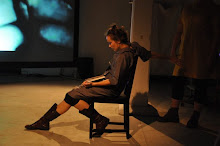
Davies' idea for the original production had the King (modeled on King George III, the sole singer in the score) interacting on stage with each of the instrumentalists, who are all in cages, representing the bullfinches that crazy George III allegedly played with during his 60 odd years of royal insanity and seclusion. There are no cages in Steier's production. And the question of whether the King is performing at all (is he performing nuts, or is he just nuts?) is updated into the psycho-scape of the ultimate vanity press: YouTube. The instrumentalists crouch on either side of a giant stage-size screen onto which the King's singing face is projected. The King himself sits behind the screen (we cannot see him, but we hear his voice), but the liveness of his performance is belied by the intervention of a camcorder. What we see is much less like a performance, and more like a blown-up home video of a guy screwing around in his bedroom.

Steier's conceit is that the singer gradually makes himself up as King George. Over the course of roughly 45 minutes, he applies a generous white base, pencils in eyebrows and beauty marks, does up his lips, and finishes off the costume with a powdered wig (which he powders, hilariously). Partly because of the making-up bit, and partly because much of the vocal part lies in a falsetto range, the effect is a bit like Dame Edna after five tequila jello shots. Peter Tsantis is a creditable singer and his rendition is not coincidentally very singerly. He has exceptional technique and despite all the noisy racket he's required to make didn't appear to be straining. The problem is that without the sense of geniune strain, the sense of genuine madness flies out the window. Other interpreters of the role (Roy Hart or Julius Eastman), have voices that seem literally to come apart as the King's reality comes apart. With Tsantis, I wasn't on the edge of my seat. (Although that may also have been due to the unwelcome narration from the man behind me who felt obliged to fill in long and goofy explanations for the benefit of his young girlfriend: "Now, you know which one's the cello, right? ... Oh, this bit's from the Messiah! Do you know the Messiah?" I turned around at one point to ask him if he'd like to step outside to fight, but came face to face with a waitress presenting him and his girl-teen with an enormous Lobster Crostini plate. Don't go to the Poisson Rouge if you like your voyeurism without the annoying chatter.)

If you're familiar with the piece, you know that the King has to emerge from under the screen at some point because there's the bit about him breaking the violinist's violin. He does eventually come out, appearing onstage in the flesh for the first time. This ought to be a big moment and it is. The screen is simply a backdrop now, and we're in the familiar world of theater. The King dutifully smashes the violin. But then, oddly, Steier has him return behind the screen, and finish the rest of the piece from there. In retrospect, the entrance onstage appears not to have been an interesting staging choice (shattering the YouTube illusion and replacing it with real-time theater), but merely the shortest way to get the King and the violin close enough for the one to beat the other into submission. The problem is that having once tossed out the YouTube conceit, it makes no sense to have the singer step behind the screen again. Once we know that the Wizard of Oz is the guy behind the curtain, he has to stop doing the schtick behind the curtain and come out and face his audience like a man. Or a queen.

There was also very little ... no, I'm gonna go with no attempt made to integrate what was happening on stage with Randolph Stow's lyrics, which are thoughtful, bizarre and strong, and which will contradict what you're doing if you're not careful. (Why would this particular King, dressing up as a woman, suddenly start raving about Esther, his queen? Whoops!) I'm all about artistic license, but if there's no attempt to align what's going on action-wise with what the King is saying, it becomes Eight Mumbles for Some Sick Sonofagun, which isn't half as interesting as what's printed in the score.

I'd still tell you to go see it, but that was the only performance. Next time.