The legitimacy of parental control mechanisms rest on a giant assumption: older people know better than young people what constitutes healthful entertainment and what harmful, dirty smut. But who's controlling the parents?
Three years ago my father discovered TiVo & immediately taped Topsy Turvy, the not exactly box office hit about Gilbert and Sullivan's rocky (to put it mildly) professional partnership. When I visit my parents in Omaha, among the usual questions (do I want some of my aunt's special sweet raspberry sauce made from fresh raspberries from her garden which she was kind enough to make specially for me and which she'll be devastated if I manage to avoid) is the unavoidable: do I want to watch Topsy Turvy with my Dad? Usually, I do. (I've seen it probably 9 times, which really begs the question of how much Dad's been dipping. Yikes!) On one hand, it's the equivalent of a child wanting to read Pooh or watch Bambie for the 9 millionth time and it's kinda cute. But if discerning the difference between an obsessive but cute habit and an obsessive and dangerous one is the job of a parent, shouldn't it be the job of the child to mitigate a parent's desire for the same when it becomes overwhelming?
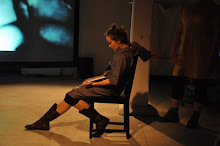
Last night at the Lyric, when the curtain fell on Katya's dead body, the entire audience shot out of their seats in an ecstasy of applause. I've never seen enthusiasm like this at the Lyric. And in this instance, it struck me as particularly strange. There was nothing special about the performance. Some of this may be Janacek's fault. There's too much moaning about how things are gonna turn out (badly) and not enough doing, so that the whole opera becomes about Katya predicting her own downfall, and there's nothing less interesting than a character who ruins the ending in scene 1. The twentieth time Katya howls about how she's going to betray her husband, we ought to be thinking "OH GOD NO! It pains me when you say that, Katya!" I was thinking, "For Pity's sake DO IT!" But the set was blander than bland (intentionally and, I think, for obvious reasons, but nevertheless, something closer to what you'd expect from Les Noces) and there was very little in the way of acting. I have a brain condition that makes auditory processing impossible when there's nothing to look at (thus the inverse of the blind leading the blind ... the as-good-as-blind leading to auditory failure? Nevermind...) but my sense was that there was also very little in the way of singing. Karita Mattila, who plays the principal role, could barely carry over the orchestra. I have a theory (which won't hold up) that Kartia Mattila is a countertenor. Her consort of conspirators (including Liora Grodnikaite, Garrett Sorenson, & Jason Collins) were -- thank God -- stronger & brighter.
But I wanna get back to this ovation (because really, what's the point of reviewing an opera if not to emphasize what happens in the moments just after [what?!]). There could not have been more excitement if the orchestra had come up onstage bearing Janacek's body in carbonite and laid it on a giant dessert tray. Last night I saw the kind of crowd behavior I expect at a rock concert; it was a collective biological urge, a swarm. The woman to my right hadn't been able to get out of her seat all night, forcing me to climb backwards out of our row to go to the WC at the break. But she shot up like some crazy zombie at the end. I think some drool might have fallen on my leg.
I'm gonna float a suggestion. The Lyric needs a mandatory parental control/threat advisory screening for subscribers as they enter the house (perhaps administered by the people in bat capes who take tickets). A short and easy questionnaire would suffice: Does this patron know and use the various gendered/plural variants of bravo (brava, bravi)? If so, add 1 point to their threat rating. Does he/she have an assigned seat that pales in comparison to his/her regular seat? (What is this, 1828?) And so on. A patron who emerges with a rating of 3 might be encouraged to stay away from the drinks table and receive a free bottle of water at the entrance to the theater plus free tickets to the next Michael Moore documentary. Patrons with a 4 would be restricted to viewing one act at a time in a separate, padded room and encouraged to review sobering financial portfolios between acts. For 5 ... barbed wire ... tranquilizers ... but what could stop these people?
Sunday, December 13, 2009

Wednesday, December 9, 2009
eighth blackbird Pierrot lunaire
Eighth blackbird's new Pierrot with staging by Mark DeChiazza debuted last night in the Harris Theater. DeChiazza is a choreographer, not a director. (This is an opinion, not a statement.) I got wind that some tech'ing problems earlier in the day had caused a bit of concern prior to the performance, and Lucy Shelton mentioned something in the talk-back about not having "lived" with the piece, code for the feeling among performers that things haven't quite got settled. Apart from the lighting, which was shady (no small task, to invent lighting cues for 21 separate pieces unto themselves; there is an opera of lighting in this short little guy), and a couple supertitle snafus, the production itself was slick. The point of the production, however, left me hanging. And the problem may have been that 8bb also felt a bit left out to dry.
Pierrot lunaire is a work all its own. It exists according to its own impenetrable logic, propelled by its own strange momentum. The point of any staging of Pierrot shouldn't be to crack the code and expose the real story because we all know there isn't one but to elaborate on that story in a compelling way. The story has 1 character, the singer, or 6 if you count the instrumentalists as characters. So, 6 characters plus in this case a dancer and a Pierrot. 8 people in a room. Good. Now, what kind of relationship do these people have to one another? It doesn't have to be transparent; in fact, it can change, continuously even. But the characters should know what these relationships are. Do they like one another, or do they not like one another? Does one character adore another who loathes him? And then, what is this landscape? Why are these characters here? Does it feel comfortable to them? Is it a place they like being? Are there memories here? And so on.
There was no text painting per se in this production, and that's fine. But there was also a marked disconnect 95 percent of the time between what Lucy was saying and what the rest of the cast was doing. To the point that the singer could be moaning about blood and gore and the 8bb'ers were simply hauling chairs around the stage. (I'm exaggerating. Somewhat.) I don't expect someone to literally stage "He stuffs a little parcel / Of fine tobacco, with finesse, / Into Cassander's shiny skull." That's not the point. But do stage something that suggests a logic of its own. Do create a stage language that's coherent unto itself and do give the people on stage a deep understanding of how to communicate in that language. Shouldn't that be top priority? Unless you convince your actors of the value of what they're doing, the risk is that they look like so many automata in a series of rotating positions. Lights up, so-and-so moves chair stage right. So-and-so dances with Lucy. Someone climbs up the ladder. No one moves. Pierrot pulls out an umbrella. If you can't convince your cast of the worth of what they're doing, they can't help but show it.
The choreographer emerged after the piece along with Lucy, Matthew Duvall (the percussionist, who had dressed up in an oversize white suit to play Pierrot himself), a single female dancer (Elyssa Dole) and the violinist (the other Matt, Matt Albert), who managed the questions. I floated the suggestion that perhaps matching text to sight had been low on the choreographer's priority list. That instead of mickey-mousing, he'd intended a world apart for the bodies of the musicians and the dancer to live in, a world full of symbols that interacted with one another in meaningful ways, and that perhaps he wouldn't mind explaining the work this world was doing and indeed, what that world was. He seemed very pleased with the question. After listening to the music, he reported, he'd begun "hearing shapes" in the music, shapes which he then translated to stage. It's a perfectly reasonable thing to hear shapes in the music. It's a perfectly reasonable thing to put them on stage. I'm afraid it just wasn't the really the cipher I was looking for to decode this thing.
I got even less help from the rest of the audience who were more interested in noting Lucy's habitation of the role (she did inhabit it, marvelously) or from the 8bb'ers, who were more interested in noting, jovially, that Matthew, the percussionist/Pierrot, had never had so few things to hit onstage. Sigh.
Among other things (George Perle, hallo?), there was a Weill set on the program. Lucy sang "Mack the Knife" very sprech, with an understated and very effective pizz'y arrangement for 8bb by 8bb'ers Lisa Kaplan (piano) and Nick Photinos (cello). The arrangements were adorable. (And thus, alas, perhaps at odds with the original spiciness of Weill, or just an indication of how long ago the firey bite of the Brecht/Weill project actually began to die.) Also on the program, Berg's Adagio from Kammerkonzert for clarinet (Michael Maccaferri), piano and violin, was by far the most enticing part of the evening. These three have done due diligence getting to know one another's musical impulses to the point that they crafted a truly a collective notion of how the piece was meant to go. The beginnings and endings of phrases could not have been better timed if they'd had a metronome on stage. My only complaint, which was foreseeable, is that -- god almighty -- whose idea was it to put these folks in the Harris Theater? I like the hall. But it swallowed this trio alive. I would have liked to hear them in a suffocatingly small space where the pianissimos had a running chance to contrast with the crescendos, and the crescendos could have had a shot at being deafening, as they should.
Tuesday, November 24, 2009
eighth blackbird, Tuesday November 17
The University of Chicago programming entity, artspeaks, opened its 2009-10 season Tuesday of last week with a performance of Osvaldo Golijov's "Ayre," featuring Dawn Upshaw and the members of eighth blackbird (yes, I've not only confirmed, I've been admonished: it's all lowercase) in addition to a few other players that included Jeremy Flower (laptop and sound design = thumbs up) and Michael Ward-Bergeman, who in my opinion stole the show (more on him later).
Upshaw's coloratura has justly earned her a reputation as an angelic singer (figuratively in Handel and literally as the Angel in Messiaen's Saint Francis of Assisi). But this particular performance involved her doing a lot more than angelic coloratura; I wish I could remember verbatim Golijov's comment about what he had in mind for the piece -- it was something along the lines of "I got really sick of writing Dawn Upshawy kinds of music for Dawn Upshaw so I decided not to this time." Has anyone ever heard Dawn Upshaw not sing like Dawn Upshaw? That's kind of what we got on Tuesday. Dawn Upshaw sang 1. mic'ed (and with variable mic levels, so that you never knew just how loud she was going to sound) and 2. in chest voice. The piece rocked out in certain places (at which points, parts of the ensemble would stand up like a big, jazzy Argentinian klezmer band and rock out with her, a nice touch of staging) and the chest voice kinda worked. Kinda. But ultimately, if you want a singer who can sing loud and chesty, you wanna write for a singer who doesn't need to protect her voice. Dawn sounded great. But somebody with a little more Arethra would've brought the house down.
I promised to say something about Michael Ward-Bergeman, who plays something called the hyper-accordion. It's as cool as it sounds. (Michael is also the only person I know who's ever been referred to as an accordiopimp.) Check him out here.

Friday, November 20, 2009
Baby Bro Done Did It Again
A shout-out (isn't what the cool kids say?) to my brother, Drew Connery, is in order. I blogged about his radio exploits less than a year ago; now it seems he's poised to become famous overnight. (Can anyone say jealous older sister?)
Along with his singer pal, Tyg, with whom he's worked on several albums, Drew has just gotten himself signed to Dungeon (otherwise known as the label that signed Outkast).
Their music is available on iTunes (The album is called "I'm a Nightmare.")
Drew, I am sincerely proud.
Along with his singer pal, Tyg, with whom he's worked on several albums, Drew has just gotten himself signed to Dungeon (otherwise known as the label that signed Outkast).
Their music is available on iTunes (The album is called "I'm a Nightmare.")
Drew, I am sincerely proud.
University of Chicago Magazine article on Opera Cabal's "USW"
This article on my beloved project, Opera Cabal turned up yesterday on the University's main page -- I'm not sure how I feel about the picture :) But press is press. Is press.
In other news, we've managed to raise half of the money we need to take this very same piece to Oberlin in February. We'll finish it there, then move on to Chicago & New York to do shows at Curtiss Hall & Galapagos!
In other news, we've managed to raise half of the money we need to take this very same piece to Oberlin in February. We'll finish it there, then move on to Chicago & New York to do shows at Curtiss Hall & Galapagos!
Wednesday, November 11, 2009
IMPROMPTU rides again...
The Mozartfragmentarypantomimereconstructionproject which I was recruited to direct for the Chicago Humanities Festival and which I've blogged about before appeared this past Monday at the University of Chicago Theater and Performance Studies Workshop . Minutes before the workshop kicked off we discovered 1. half the costumes were gone, including Jonathan DeSouza's entire costume and that 2. toenails (mine) react badly to being mowed over with pianos. Undeterred, this weekend we/the show travel/s to the American Musicological Society annual conference in Philadelphia to participate in its first year of experimental performance panels ... whoo hoo!
Saturday, October 24, 2009
Anne LeBaron @ U of C
Anne LeBaron presented this past Friday to a (rather poorly -- yikes!) attended colloquium in Fulton Hall. The subject: her opera, Sucktion. LeBaron's work sounds immediately fascinating. Here's a random selection from her very impressive CV: she won a Guggenheim, studied with Ligeti (not in that order), has written a "dance opera" called Pope Joan, and Wet, another opera about the big business of water and the horrors of floods and she, I'm quoting, lectures at CalArts on the "concept of HyperOpera." (I don't know what this means but surely it is meant to address the hyper, erratic, overblown aspect of opera--aspect, or sine qua non--that is, the histrionic too-muchness of opera, perhaps in order to address what happens when the "Opera/Too-much" dial continues to be turned even further up, up, up?)
In the beginning of her lecture Anne charmed us by revealing a years-long fascination with old vacuum cleaners and vacuum cleaner sounds. She played us early samples of her work, female vocalizations layered on top of recorded & processed vacuum sounds. At times the two seemed uncannily to merge, and at one point, LeBaron had the vocalist spit and buzz into the vacuum mouthpiece to produce a series of fun sounds that would probably make Kaija Saariaho jealous. LeBaron's collaborators on Sucktion include the poet Douglas Kearney, whose libretto is a clever homage to Marinetti typeface. This all seemed promising.
LeBaron saved the nugget of her presentation for last -- that is, the semi-finished, workshop staging of the opera in L.A. But this is where things started to go downhill. LeBaron later mentioned she feared that 40 minutes of vacuum sounds weren't in and of themselves interesting enough to justify the ticket prices (okay, I made that part up, but she did say she was worried the vacuuming lacked moxy) so she crafted a heavy-handed scenario to go along with them. (For the record, vacuum sounds are TOTALLY interesting. Maybe not for forty minutes, sure, but for at least 25. If John Cage can get away with Points in Space, I say go for it!)
Oppressed housewife cleans house, anticipating the arrival of her husband home from work. (The singer/actress in this case was Asian, and one grad student floated the thought that LeBaron intended the opera as a critique of interracial marriage. Or better, I thought, that the Mail Order Bride phenomenon in this country replicates/updates in the 21st century the phenomenon of the overbored, undersexed housewife of the 1950s? But LeBaron seemed uninterested; or else this was my private flight of fancy. Anyway.)
The husband arrives home (a recorded voice-over, "Honey, I'm Home"; i.e. there is no "husband"), finds the place a mess & retires for the night. Depressed, the housewife turns melancholy. A vacuum arrives. A present from her hubby. She falls in love (with the vacuum), sprawls on it orgasmically and thus the comedy endeth.
To put it simply, the problem? Too much scenario and too literal.
1. Put the husband in a locked closet stage left so that the "housewife" (or is she a dominatrix? an updated Alcina?) controls his exits and entrances.
2. Or make it Erwartung Appliance! Instead of losing her fiancé, this poor woman is in denial over the death of her beloved vacuum.
3. Or make the husband's cleanliness phobia the center of the (o_p)/e(r?)a and his hapless wife the Mrs. Haversham of the Ace Hardware Cleaning aisle.
A dash of the intellectual wit that has made LeBaron such a successful composer and a writer is needed. Instead, the staging we saw consisted of the soprano (who, by the way, is a musicologist and member of the group that commissioned the opera) putting on and taking off rubber gloves, stuffing them into her oversize apron pockets, dropping them, and putting them on again. LeBaron's score, and her ideas, play happily far off of the beaten path. But this opera needs a director so that the curiosity that motivated its inception gets taken up a notch. Staging, to honor its points of origin (the ideation of the opera, the wit and spirit of adventurousness that composers like LeBaron bring to the table), should amplify, qualify & problematize that origin; not bow to it.
Subscribe to:
Posts (Atom)