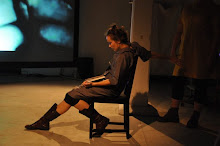
Matt Morgan, are you out there in cyberspace? You need to know how profoundly happy I am to have discovered George Steiner, and my gratitude to you (as the intermediary who arranged that discovery) runs deep. I had started to think that religious feeling meant academic suicide. God + academia = lost cause. But lo! As it turns out, one can turn to academia, and, in the best of cases, do it precisely as a theologian.
But there's more! And more important: George knows about art.
Art is life. For me. I'm not trying to be pretentious. And here's how I know I'm not being pretentious: it's a drawback. It doesn't win friends.
I can't stop acting. Or, can't ever make the feeling of acting go away. It doesn't mean I'm faking the whole way through life. It's just how it is. If I were a book binder I would be binding up things all over the house and if I raised butterflies for a living I would sleep in butterfly gauze and dream butterfly dreams.
George says that all art is an attempt at communication (not necessarily communicating, but definitely trying). And why? The dread of solitude. "The rapture of Narcissus is, tautologically, that of suicide." Ack! We who need other people need art because we're hopeless at talking to other people. We'll try anything. But whoa there! Some people who need art ... don't need people. {??!!}
Yes, George. There are! "The notion of a poet writing verse in a private tongue or destroying what he has written, of a painter refusing to show any canvas to an eye other than his own, of a composer 'performing' his score in mute, purely inward audition, is conceivable" but unlikely. You're implying it doesn't happen, George, but it does! (George says that Gogol burned the second half of Dead Souls out of fear of the "other's intrusion." I'm doubting.)
There is another kind of artist, the kind I am not, the kind I envy with all my heart. How many artists I know crave aloneness and lavish their attention on the gritty pleasure of making. Not making for. These are the good little players who as four-year-olds sat all day around tiny creations arranging, enacting, dissecting. I spent my childhood terrorized by lonesomeness. I have a terrible imagination.
When I'm afraid of isolation I drive around all night to be surrounded by other people driving. I'll sit in an airport to see people walking around.
George, as far as I know, you've written a lot of books. Which means you probably spend a lot of time alone too.
At least I have the endless vault of cyberspace to project my woes into. What would I do without you?
Sunday, December 28, 2008

Thursday, October 2, 2008
Lipstick on a Pig
Sarah Palin needs to run back to her ice floes and Iron Dog races. Let's just enjoy the thought of that ...
Written and directed by David Bashwiner, performed by David Bashwiner, Majel Connery, Richard Whaling and an unknown party; video and editing by Ben Kolak.
Monday, August 25, 2008
The Olympics: A Review
I have always had a creeping intuition (the devil that sits on my left shoulder, or maybe it's the one that's lodged in my bellybutton; I think the OCD devil sits on the left shoulder -- anyway, I forget, there are so many of them) that something is wrong with the Olympics, or that something was BECOMING wrong with them. Now, don't misunderstand. I love the Olympics. So much so that, not being a TV owner myself, I have had to wrangle forced TV sittings out of certain best friends during these last couple of weeks (their generosity should not go unnoted).
But here's the thing: I don't watch other sports. At all. But there is something about the Olympics that goes beyond the merely sportly. The Olympics is myth: Olympia! Gymnastic feats! Wrestling three-headed dogs! Breaking down the gates of Hades with your discus and javelin power tools! The Olympics is not about courts and scoreboards and whether the female volleyball players' tankinis are actually just bikinis. It's about pure and simple might; domination. Outrun that guy. Jump higher. Pull a ridiculous extra fly stroke out of nowhere and beat your opponent by a millisecond. It's about the simple feats that the human body (the BEAUTIFUL human body, O Lord) can accomplish without brand name gear in bare feet with bleeding sockets and foaming mouth. So, now, when I see badminton become a part of the Olympics, let alone basketball (excuse me, but don't they have enough TV coverage already for chrissake?) the chagrin starts to set in. My purist's event has a dirty strain in it and it's called organized sports.
But here's the thing: I don't watch other sports. At all. But there is something about the Olympics that goes beyond the merely sportly. The Olympics is myth: Olympia! Gymnastic feats! Wrestling three-headed dogs! Breaking down the gates of Hades with your discus and javelin power tools! The Olympics is not about courts and scoreboards and whether the female volleyball players' tankinis are actually just bikinis. It's about pure and simple might; domination. Outrun that guy. Jump higher. Pull a ridiculous extra fly stroke out of nowhere and beat your opponent by a millisecond. It's about the simple feats that the human body (the BEAUTIFUL human body, O Lord) can accomplish without brand name gear in bare feet with bleeding sockets and foaming mouth. So, now, when I see badminton become a part of the Olympics, let alone basketball (excuse me, but don't they have enough TV coverage already for chrissake?) the chagrin starts to set in. My purist's event has a dirty strain in it and it's called organized sports.
Now, my friend Laura has a boyfriend named John who is full of chagrin. And what I'm about to post here, well, these are not my words, but sadly, the words I want to have written but couldn't put into terms concise and biting enough for my taste and so, twice sadly, left them unwritten. Here's John on the Olympics:
"The Rules: only those sports that measure strength or endurance or both are allowed. The use of simple mechanical devices is okay (bicycle, rowing shell). Any sports that simulate warfare are acceptable (boxing, taikwondo). No sports that are too cool (like snowboarding, moto-cross, demolition derby or whatever they had in Turino). No ball sports.
Tennis. No. Didn't we just have Wimbeldon? What the hell is the Olympics for?
Table tennis: Obviously no, unless the players are too drunk to drive legally. Then it's okay.
Volleyball: Only if they play the top gun soundtrack on repeat. Otherwise, no.
Diving: Only if the contest is about how high you can jump from and survive.
Equestrian: The horse deserves a medal, too, if not more so.
Field hockey: Only if they're hot and wear plaid skirts. And that includes the men. All field hockey players wear skirts. No sweating allowed. Attractiveness counts. Otherwise, no.
Tennis. No. Didn't we just have Wimbeldon? What the hell is the Olympics for?
Table tennis: Obviously no, unless the players are too drunk to drive legally. Then it's okay.
Volleyball: Only if they play the top gun soundtrack on repeat. Otherwise, no.
Diving: Only if the contest is about how high you can jump from and survive.
Equestrian: The horse deserves a medal, too, if not more so.
Field hockey: Only if they're hot and wear plaid skirts. And that includes the men. All field hockey players wear skirts. No sweating allowed. Attractiveness counts. Otherwise, no.
Waterpolo: No. too . . . weird.
Basketball: No. Kobe Bryant gets enough attention.
Synchronized swimming: Come on. Let's be realistic about this.
Sailing: The boats should be equipped with cannons.
Trampoline: See 'Diving', but in reverse.
Softball: No. Can you imagine someone working his ass off to become a male Olympic softball player? Sounds like a Will Ferrell / Ben Stiller movie. (It's a women-only event, but I like the image. Still a ball sport, so not allowed).
Badminton: Absolutely not. I don't care how much the Chinese love the sport. Even if the shuttlecock or whatever isn't precisely a ball, it's close enough.
Canoeing: Only the events that don't go downstream. Why not dump them out the back of a plane? Flat water events only.
Handball: Are you kidding? Is it restricted to six-year olds? No.
Baseball: No way. We always lose anyway. Embarrassing."
A man after my own heart. Thanks, John. You said it exactly.
Basketball: No. Kobe Bryant gets enough attention.
Synchronized swimming: Come on. Let's be realistic about this.
Sailing: The boats should be equipped with cannons.
Trampoline: See 'Diving', but in reverse.
Softball: No. Can you imagine someone working his ass off to become a male Olympic softball player? Sounds like a Will Ferrell / Ben Stiller movie. (It's a women-only event, but I like the image. Still a ball sport, so not allowed).
Badminton: Absolutely not. I don't care how much the Chinese love the sport. Even if the shuttlecock or whatever isn't precisely a ball, it's close enough.
Canoeing: Only the events that don't go downstream. Why not dump them out the back of a plane? Flat water events only.
Handball: Are you kidding? Is it restricted to six-year olds? No.
Baseball: No way. We always lose anyway. Embarrassing."
A man after my own heart. Thanks, John. You said it exactly.
Friday, June 6, 2008
Back to the Past
Readers, I love you.
Thanks for your support, glib jokes, criticism, threats and angry rejoinders. Happy to be back for the summer in Chicago, where no one thinks I'm Norwegian, I'll be posting on the Opera Cabal main page.
Thanks for your support, glib jokes, criticism, threats and angry rejoinders. Happy to be back for the summer in Chicago, where no one thinks I'm Norwegian, I'll be posting on the Opera Cabal main page.
Wednesday, May 28, 2008
I'm suffering for content, people ...
Seventh grade was probably the worst year of my life. All my fears -- about everything -- originated in junior high school. Among other absurd things I wish I could forget about this period of time was a class I took called Reading. I have no recollection, apart from the obvious, of what we accomplished in this class. But I do remember that on Mondays we were expected to show up with a book, any book, and to sit and read silently for the duration of class. Much as, as an adult, I would now consider this, like required nap time, to be a class sent by God, it's really shocking how hard it was for our teacher to organize an activity as progressive as silent reading when it involved a bunch of 12-year-olds. First of all, after a weekend of who knows what you do when you're twelve, what preteen could remember to bring a book to school (like, where do you even find those)? And did she really expect 25 kids to sit quietly for an entire hour? It's not that it was an inherently bad idea. It's just that ... IT WAS AN INHERENTLY BAD IDEA! If you've been a junior high teacher for longer than about nine minutes, you would know that this would never work. And sure enough, after the inaugural Monday silent read session, during which three or four kids got kicked out and probably half the rest of us given detention, she probably should have taken another angle, like, I dunno, reading out loud. But she stuck to her guns and made herself and us miserable for the rest of the year.
I wasn't one of the bad kids in the class, but I was the kid who never remembered, not even once, to take a book to class, and every Monday afternoon I had to walk up to this teacher's desk, look at my shoes, express my regret, and ask to go back to my locker to retrieve the book that I, along with the rest of my fellow students, would then not read for the next hour. This teacher did not understand my forgetfulness, and her displeasure with me for some reason made it more and more unlikely every week that I would ever actually remember to do what I was supposed to do. Negative reinforcement? Doesn't work.
One Monday about five or six weeks into the term, I was so mortified at having yet again neglected to bring my f-ing book that I decided, rather than announcing what I'd done, I would instead PRETEND I that I did have a book in my lap, and I would pretend for one, long hour to read it. Acting quickly, behind my desk I scrunched up my legs into a tight ball, placed my imaginary book in front of them, and stuck my face down close to my legs and the "book" and didn't look up for a second. I'm not sure if I really believed this would work, but it certainly would have been easier to pull off from the back of the class since there at least I would have been hidden by the level of activity going on in front of me. Unfortunately, in my desperation to become a better student I had chosen a permanent seat in the first row of the class. Still, for awhile it seemed to be working except that the kid next to me couldn't control his laughter. I calmly scanned from one side of my legs to the other and tried to look engrossed. The thought crossed my mind that I wasn't actually sure I could stare at my legs for an hour, but then I realized I'd been found out. How, I don't know, but I looked up, and the teacher was staring at me with the kind of irritation that if I remember correctly is common among long-since faded and resentful people who regret having chosen to work with children. She asked me, "Majel. What are you doing?"
The reason I'm telling you this story is because it actually relates to our work here at Den Norske Opera. We had our dress rehearsal last night, and while I won't say it was a complete and utter ruin, Christopher came damn near close to walking out even before the curtain. For weeks he's been telling the folks on the technical team, all Norwegians, that he needed to see the English and Norwegian translations they were were planning to use as subtitles for the libretto, and insisting they do a trial run with the subtitle screens on the backs of the chairs in the audience BEFORE THE DRESS REHEARSAL. The problem with a brand new opera house is that all the technology is also brand new, and nobody has any idea how to get it to work. The orchestra pit wasn't even built when we moved into the stage space, and people are continually falling off the steps into the pit. The curtain stopped halfway across the stage the first time we used it. There aren't even any house lights. When you're in the audience and you need to see anything, they have to turn on a big halogen bulb that could burn your eyes out, and that's suspended from the ceiling on a big power cord. No one seems to know where anything is, or even if they did know, how to do the right thing with it. Poor Paul, the stage designer, asked five weeks ago for a few patches to be mended in the wood panels on the back wall of the set. It's still not done and one day before the premiere, it's not looking like it'll get done. Last night, the poor fool running the subtitles kept blowing all the big lines by getting there too fast. They have 24 hours.
I wasn't one of the bad kids in the class, but I was the kid who never remembered, not even once, to take a book to class, and every Monday afternoon I had to walk up to this teacher's desk, look at my shoes, express my regret, and ask to go back to my locker to retrieve the book that I, along with the rest of my fellow students, would then not read for the next hour. This teacher did not understand my forgetfulness, and her displeasure with me for some reason made it more and more unlikely every week that I would ever actually remember to do what I was supposed to do. Negative reinforcement? Doesn't work.
One Monday about five or six weeks into the term, I was so mortified at having yet again neglected to bring my f-ing book that I decided, rather than announcing what I'd done, I would instead PRETEND I that I did have a book in my lap, and I would pretend for one, long hour to read it. Acting quickly, behind my desk I scrunched up my legs into a tight ball, placed my imaginary book in front of them, and stuck my face down close to my legs and the "book" and didn't look up for a second. I'm not sure if I really believed this would work, but it certainly would have been easier to pull off from the back of the class since there at least I would have been hidden by the level of activity going on in front of me. Unfortunately, in my desperation to become a better student I had chosen a permanent seat in the first row of the class. Still, for awhile it seemed to be working except that the kid next to me couldn't control his laughter. I calmly scanned from one side of my legs to the other and tried to look engrossed. The thought crossed my mind that I wasn't actually sure I could stare at my legs for an hour, but then I realized I'd been found out. How, I don't know, but I looked up, and the teacher was staring at me with the kind of irritation that if I remember correctly is common among long-since faded and resentful people who regret having chosen to work with children. She asked me, "Majel. What are you doing?"
The reason I'm telling you this story is because it actually relates to our work here at Den Norske Opera. We had our dress rehearsal last night, and while I won't say it was a complete and utter ruin, Christopher came damn near close to walking out even before the curtain. For weeks he's been telling the folks on the technical team, all Norwegians, that he needed to see the English and Norwegian translations they were were planning to use as subtitles for the libretto, and insisting they do a trial run with the subtitle screens on the backs of the chairs in the audience BEFORE THE DRESS REHEARSAL. The problem with a brand new opera house is that all the technology is also brand new, and nobody has any idea how to get it to work. The orchestra pit wasn't even built when we moved into the stage space, and people are continually falling off the steps into the pit. The curtain stopped halfway across the stage the first time we used it. There aren't even any house lights. When you're in the audience and you need to see anything, they have to turn on a big halogen bulb that could burn your eyes out, and that's suspended from the ceiling on a big power cord. No one seems to know where anything is, or even if they did know, how to do the right thing with it. Poor Paul, the stage designer, asked five weeks ago for a few patches to be mended in the wood panels on the back wall of the set. It's still not done and one day before the premiere, it's not looking like it'll get done. Last night, the poor fool running the subtitles kept blowing all the big lines by getting there too fast. They have 24 hours.
Tuesday, May 20, 2008
Descending into L'Orfeo
Orpheus loves Eurydice. Eurydice doesn't love Orpheus. He pines and finally, he woes her. On their wedding day, she's gathering flowers and stumbles into a nest of vipers, and like all dead Greeks, Eurydice descends into Hell. But Orpheus, no quitter he, suffers from the force of such denial of her death that he goes to the portal of Hell, where, having no money, he charms free passage by singing Charon a song. Down in the land of the dead, Orpheus softens the heart of Persephone,* who persuades Hades to allow Eurydice to go with Orpheus back up to earth, provided he can prevent himself from looking at her on the way up. As in all stories with an impossible object, Orpheus fails.
The variations of the Orpheus myth are legion, especially when it comes to Orpheus's big blunder. According to Plato, Orpheus was right to doubt that Eurydice accompanied him back to earth -- Hades had actually sent something back with him that sounded like Eurydice, but it wasn't actually the real thing. Virgil's completely unsympathetic telling has Orpheus actually making it back to earth without turning around. But then he forgets that Eurydice has two more steps to go and loses her just at the moment she comes into the sunlight. And in Aeschylus, Orpheus's OWN death is about as bad as it gets. First, he's torn to pieces, and then, if that weren't bad enough, his decapitated head, floating gently down the river Hebrus, keeps ... on ... singing. GAG!

And let's not forget the variations on the ending. Though Joseph Kerman famously (well, if you're a musicologist, famously) found Monteverdi's ending a bit Hollywood (Orpheus and his Dad, Apollo, ascend to heaven to some of the most mechanical and undramatic music Monteverdi ever composed) but Gluck's he thinks is just downright offensive (Orpheus, having in a strange twist decided to commit suicide over his wife's death, is suddenly told that the whole thing was a fake and Eurydice simply wakes up).
Christopher Alden's staging of L'Orfeo (the Monteverdi version, the earlier version) works for me. But if you get online and look for reviews of past productions at Glimmerglass and Leeds, they're all scathing. People hated the production. Even people I know and love hated it. And believe me, I understand why. Christopher is avant-garde to the nines. His characters smoke and drink cocktails on stage; they wear sexy outfits; and probably worst of all, there's oftentimes not much of a relationship between the libretto and his dramatic conception. Sometimes, there's almost none. Forget what you thought you knew about important climactic moments. The arrival of the messenger who informs Orfeo that Euridice has died? Nah, she doesn't arrive. She's been sitting on the sidelines right in the same room with Orfeo. She didn't even see it happen. And Orfeo's ascent to heaven? Yeah, actually, he's just gonna sit brooding pathetically in a chair center stage, until the last blackout. Oh, and Euridice is on stage with him. I mean, she's dead but ... she's still there.
Christopher paints in broad strokes. It's the difference between plot, what happens blow-by-blow (which, in this opera, we already know and DON'T need to be reminded of) and drama. And by drama I mean stuff happening. You're sitting on a park bench and two people are having a strangely animated conversation. You can't hear the words, but you're watching anyway. It's drama. There's a car crash. It looks horrible. You try to look away, but you can't: it's drama. I've gone to a lot of theater in the last couple of months where I didn't understand a word, and couldn't have described the plot to you if you'd hung a brownie sundae on a string in front of me and begged me to. But drama is the STUFF, people! You don't need language. It's better with, obviously. But that's not where the tension or the electricity or the bodies or the tears are, and to all you libretto people out there I'm sorry that I'm a slobbering disciple of Joseph Kerman but that's how it is with me.
So, what happens if you take plot out of Orfeo and add drama?
Well, Act I of Monteverdi's L'Orfeo basically boils down to a bunch of people hanging out together in a really weird looking room having a really weird looking party. Like all parties that are worth their weight, there are some drinks, and partial nudity. Period costumes are boring; here it's more like half and half: half Greek, and half something else. Renaissance ruffs, leopard print tights, biker gear, army-navy supply store paraphernalia ...

So far so good. Now, Orfeo loves Euridice. But isn't it a little strange that he had to pursue her for so long? And isn't it a little strange that after refusing him for so long Euridice would suddenly just ... change her mind? So why don't we just state the obvious. Orfeo is a complete obsessive! He should've gotten over her a LONG time ago! And Euridice has problems. In fact, she's depressed. It's not a healthy relationship.

In Act II Euridice leaves to hang out with her friends while Orfeo stays with the boys for awhile. It's a bachelor party. Everybody gets tipsy, they take off some clothes. And then the messenger shows up with bad news.

But come on. We all know this play. Euridice doesn't actually have to die; how boring. Better yet, let's duct tape her to the wall and call that "Dead" and then draw one enormous line down the center of the stage and call one side "Hell" and the other side "Not Hell." Orfeo can't cross the line.

And he pulls out a hoodie so he won't be tempted to look at anybody.

Anyway, you see how things begin to get a little out of hand. And of course there's more. Apollo walks around the entire show with a microphone pointed at Orfeo to record everything he sings, bootlegging all of the big musical moments. When Orfeo puts Caronte to sleep, the cast cheers and paper dollars start falling out of the sky like he'd won the lottery.
The difference between me and the other REAL reviewers out there is that I see no harm in these things. Moreover, I challenge YOU to come up with a challenging reading of a billion year old myth, one that engages with the same old basic tale and wrestles something strange and unexpected out of it. It's an experiment, people. It won't hurt you. Who wants to see the same sappy story again? Give me opera that goes out on a limb, or give me the death of opera. I've said it before, and I'll say it again: it WILL happen.
*Incidentally, it's a pretty a good thing that Persephone happened to be serving her yearly six-month sentence down in Hell when Orpheus arrived with his sob story. But wait a minute. If Persephone is in Hell, and you can ask Edith Hamilton if you don't believe me, then it has to be winter upstairs. But if it had been winter when Orpheus and Eurydice tied the knot they wouldn't have been zipping around in flowering fields waiting to run right into a big, fat snake den. Has anyone ever noticed this? PERSEPHONE SHOULDN'T EVEN BE THERE! HA HA, OVID!
**Lest the excellency of the photographs I post here deceive you, these are not mine, but George Mott's, taken during preparations for the opera at Glimmerglass in 2007. You can see more pictures of the opera on Christopher's website, which is where I found them.
The variations of the Orpheus myth are legion, especially when it comes to Orpheus's big blunder. According to Plato, Orpheus was right to doubt that Eurydice accompanied him back to earth -- Hades had actually sent something back with him that sounded like Eurydice, but it wasn't actually the real thing. Virgil's completely unsympathetic telling has Orpheus actually making it back to earth without turning around. But then he forgets that Eurydice has two more steps to go and loses her just at the moment she comes into the sunlight. And in Aeschylus, Orpheus's OWN death is about as bad as it gets. First, he's torn to pieces, and then, if that weren't bad enough, his decapitated head, floating gently down the river Hebrus, keeps ... on ... singing. GAG!

And let's not forget the variations on the ending. Though Joseph Kerman famously (well, if you're a musicologist, famously) found Monteverdi's ending a bit Hollywood (Orpheus and his Dad, Apollo, ascend to heaven to some of the most mechanical and undramatic music Monteverdi ever composed) but Gluck's he thinks is just downright offensive (Orpheus, having in a strange twist decided to commit suicide over his wife's death, is suddenly told that the whole thing was a fake and Eurydice simply wakes up).
Christopher Alden's staging of L'Orfeo (the Monteverdi version, the earlier version) works for me. But if you get online and look for reviews of past productions at Glimmerglass and Leeds, they're all scathing. People hated the production. Even people I know and love hated it. And believe me, I understand why. Christopher is avant-garde to the nines. His characters smoke and drink cocktails on stage; they wear sexy outfits; and probably worst of all, there's oftentimes not much of a relationship between the libretto and his dramatic conception. Sometimes, there's almost none. Forget what you thought you knew about important climactic moments. The arrival of the messenger who informs Orfeo that Euridice has died? Nah, she doesn't arrive. She's been sitting on the sidelines right in the same room with Orfeo. She didn't even see it happen. And Orfeo's ascent to heaven? Yeah, actually, he's just gonna sit brooding pathetically in a chair center stage, until the last blackout. Oh, and Euridice is on stage with him. I mean, she's dead but ... she's still there.
Christopher paints in broad strokes. It's the difference between plot, what happens blow-by-blow (which, in this opera, we already know and DON'T need to be reminded of) and drama. And by drama I mean stuff happening. You're sitting on a park bench and two people are having a strangely animated conversation. You can't hear the words, but you're watching anyway. It's drama. There's a car crash. It looks horrible. You try to look away, but you can't: it's drama. I've gone to a lot of theater in the last couple of months where I didn't understand a word, and couldn't have described the plot to you if you'd hung a brownie sundae on a string in front of me and begged me to. But drama is the STUFF, people! You don't need language. It's better with, obviously. But that's not where the tension or the electricity or the bodies or the tears are, and to all you libretto people out there I'm sorry that I'm a slobbering disciple of Joseph Kerman but that's how it is with me.
So, what happens if you take plot out of Orfeo and add drama?
Well, Act I of Monteverdi's L'Orfeo basically boils down to a bunch of people hanging out together in a really weird looking room having a really weird looking party. Like all parties that are worth their weight, there are some drinks, and partial nudity. Period costumes are boring; here it's more like half and half: half Greek, and half something else. Renaissance ruffs, leopard print tights, biker gear, army-navy supply store paraphernalia ...

So far so good. Now, Orfeo loves Euridice. But isn't it a little strange that he had to pursue her for so long? And isn't it a little strange that after refusing him for so long Euridice would suddenly just ... change her mind? So why don't we just state the obvious. Orfeo is a complete obsessive! He should've gotten over her a LONG time ago! And Euridice has problems. In fact, she's depressed. It's not a healthy relationship.

In Act II Euridice leaves to hang out with her friends while Orfeo stays with the boys for awhile. It's a bachelor party. Everybody gets tipsy, they take off some clothes. And then the messenger shows up with bad news.

But come on. We all know this play. Euridice doesn't actually have to die; how boring. Better yet, let's duct tape her to the wall and call that "Dead" and then draw one enormous line down the center of the stage and call one side "Hell" and the other side "Not Hell." Orfeo can't cross the line.

And he pulls out a hoodie so he won't be tempted to look at anybody.

Anyway, you see how things begin to get a little out of hand. And of course there's more. Apollo walks around the entire show with a microphone pointed at Orfeo to record everything he sings, bootlegging all of the big musical moments. When Orfeo puts Caronte to sleep, the cast cheers and paper dollars start falling out of the sky like he'd won the lottery.
The difference between me and the other REAL reviewers out there is that I see no harm in these things. Moreover, I challenge YOU to come up with a challenging reading of a billion year old myth, one that engages with the same old basic tale and wrestles something strange and unexpected out of it. It's an experiment, people. It won't hurt you. Who wants to see the same sappy story again? Give me opera that goes out on a limb, or give me the death of opera. I've said it before, and I'll say it again: it WILL happen.
*Incidentally, it's a pretty a good thing that Persephone happened to be serving her yearly six-month sentence down in Hell when Orpheus arrived with his sob story. But wait a minute. If Persephone is in Hell, and you can ask Edith Hamilton if you don't believe me, then it has to be winter upstairs. But if it had been winter when Orpheus and Eurydice tied the knot they wouldn't have been zipping around in flowering fields waiting to run right into a big, fat snake den. Has anyone ever noticed this? PERSEPHONE SHOULDN'T EVEN BE THERE! HA HA, OVID!
**Lest the excellency of the photographs I post here deceive you, these are not mine, but George Mott's, taken during preparations for the opera at Glimmerglass in 2007. You can see more pictures of the opera on Christopher's website, which is where I found them.
Saturday, May 17, 2008
The 17th of Maj
Today, May 17th (or Maj, in Norwegian) is National Day in Norway. It's a holiday with only one problem. National *what* day? National Pleather Day? But like all holidays that don't begin and end with santas or bunnies, the complexity of something like an actual object of celebration isn't really what's important. Just stick to the basics: Engage in group behavior. Beer is involved on a massive scale. Eat as much as possible; don't sleep until it's over. And in Norway, bring your karaoke machine.
Oslo is small enough that the whole town turns itself into a college campus overnight. I was out till three a.m. yesterday having the night of my life and fully intended on getting up at 9a with the rest of my Norwegian ingroup to make the trek down to the palace where every 17th of Maj the royal family stands and waves from the royal balcony at passers-by. But my baser instincts kicked in and instead, waking two hours too late for Champagne Breakfast (the first event of the day), I settled down snug and warm to watch Channel 3. Channel 3 involves a young woman seemingly from Southern California, but speaking perfect Norwegian, sitting in a director's chair looking at a single-view camera. It's a very simple show. She tosses her bleached hair and wriggles in barely-there clothing, giggling and shouting unholy commentary into the camera for hours nonstop. It's like spring break for a party of one. I'm probably the only person who watches this channel. It's terrible.
My window looks out on the main street. Grown men and women are staggering around singing drinking songs and waving flags. A few older people are peering out over their balconies with fear in their eyes. National Day would be better known as National Blow-off Day. Or National Regression Day. I thought I might do some laundry.
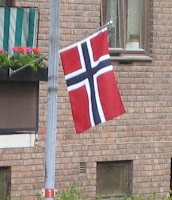
But first, a quiz. For one point: can you point to the Norwegian flag? Bonus question: which flag isn't the Norwegian flag, and what is it?

Oslo is small enough that the whole town turns itself into a college campus overnight. I was out till three a.m. yesterday having the night of my life and fully intended on getting up at 9a with the rest of my Norwegian ingroup to make the trek down to the palace where every 17th of Maj the royal family stands and waves from the royal balcony at passers-by. But my baser instincts kicked in and instead, waking two hours too late for Champagne Breakfast (the first event of the day), I settled down snug and warm to watch Channel 3. Channel 3 involves a young woman seemingly from Southern California, but speaking perfect Norwegian, sitting in a director's chair looking at a single-view camera. It's a very simple show. She tosses her bleached hair and wriggles in barely-there clothing, giggling and shouting unholy commentary into the camera for hours nonstop. It's like spring break for a party of one. I'm probably the only person who watches this channel. It's terrible.
My window looks out on the main street. Grown men and women are staggering around singing drinking songs and waving flags. A few older people are peering out over their balconies with fear in their eyes. National Day would be better known as National Blow-off Day. Or National Regression Day. I thought I might do some laundry.
But first, a quiz. For one point: can you point to the Norwegian flag? Bonus question: which flag isn't the Norwegian flag, and what is it?


Subscribe to:
Posts (Atom)