I'll start with the great idea. What could be more exciting than John Zorn composing a monodrama? Better than an opera, because weirder. But who knew that John Zorn would write that opera? It happens sometimes that really interesting people do uninteresting things. Mark Morris, for instance, recently picked up conducting. (I'm not making this up.) John Zorn is a fabulously interesting musician. His one and only opera? Like a score from some grad student at UCSD. There was no moxy in this opera, no pizzazz. No John Zorn. I don't get it. I don't want to belittle the score, because it sounded hard as all get out. Nor do I want to belittle the soprano, Anu Komsi, who I am certain knocked her socks off to learn that role. But I don't appreciate opera because it sounds hard. I appreciate it because it sounds good, or at least interesting.
Now, this guy, Michael Counts, the director, is a super interesting choice. Michael Counts runs a gaming company. That's right, like video games. His company, Counts Media (this is from their website): "is a mixed-reality gaming company that creates arts-driven entertainment experiences which celebrate the oft-overlooked details and invisible stories that comprise our everyday lives. Based in New York City, [it] combine[s] imagination, emerging technologies and urban research to produce mobile games, theatrical entertainment, viral media, public art, and tours." How cool is that? Super cool! What a great idea! And, sure enough, there were some gaming elements in the monodramas that were spectacular. In the Zorn piece, massive thought bubbles (we're talking 5 times the height of a person) emerge to hover over the actors' heads, as though channeling their inner, silent monologue. And what appears projected in the thought bubbles are an animated version of some of Artaud's last drawings, and they're really creepy and cool to look at. Ah, it's Artaud!

Ah, it's Artaud's brain!

Also, the transition between the Zorn piece and Erwartung was by far the most nifty set change I've ever seen. Over the sound of crickets humming, another (but massive this time, massive) comment bubble appears over the head of a woman onstage, and the graphics in the bubble are gorgeous. It was pure genius.
But Michael Counts is not an ingenious director. He's pretty good as a stage designer, but when it comes to working with singers and dancers, there was just no juice. No real consensus about what was even going on. The Zorn piece opens (somewhat, I don't know, thoughtlessly? egregiously?) with rows upon rows of actors wearing very severe head-to-toe hijabs -- floor-length Islamic female coverings. But with no apparent connection to the piece on any level, the choice struck me as nothing short of bewildering.
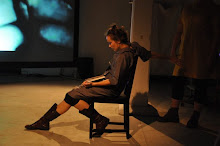
And Erwartung, alas, was about as flat dramatically as a hysterical solo mad scene could be (and if you thought a hysterical solo mad scene couldn't be dramatically flat, well, then guess again). I hesitate to comment on the singer's performance because A. I was in the fourth ring, so maybe I just couldn't see her, but also because B. she was given absolutely nothing compelling to do. What went wrong? Erwartung should be weird and scary. Now, we know from horror flicks that the scariest thing you can do in a scary movie is to not show whatever the scary thing is until the last possible moment. The minute we get a full-on shot of the alien or monster or whatever it is, it's over. We see the goofiness of the costume, the latex, the fake blood, or whatever it is and it ruins the suspense. The same rule applies in psychological drama and it definitely applies to psycho monodrama. In Erwartung what's scary is that we don't know what's going on with this woman. So the best thing to do to keep us interested is not to explain anything. Keep us confused! Keep us guessing. (Is she crazy? I don't know! I can't tell!) Counts, for whatever reason, decided to explain the woman's madness as a literal split personality -- there are 7 or so other dancing replicas of this woman running around on stage either getting in her way or helping her out or enacting little dramas of their own off to the side. The problem is that once we see the madness running around onstage in the form of 8 little ladies, it's just not as interesting as worrying about this poor woman's inner bifurcation, the invisible dilemma that drives her endless song. And by the way, I wish I could disagree with myself on this point, but it's just a bad idea to put dancers next to singers. Unless you've got a singer who is incredibly confident and knows how to use her body on stage, next to the lithe, mobile body of a dancer, she will look stiff and hopeless and we will feel terrible for her.
In defense of this performance, I will say that the last 5 minutes were absolutely stunning. Suddenly, with no time left, the stage clears and the body of the man who has been on stage all along (looking very much like a dummy--I would have put money on it) suddenly starts to rise. But he rises from the tips of his toes in an enormous arching backbend and it happens so slowly you would swear it was digitally engineered. Behind him, the man's hat floats off its place on the ground and gently wafts toward his head. This is the kind of knock-out moment I would expect to see when a gaming wizard meets the City Opera mainstage. I just would have liked to see a lot more.
George, I really think you're making some good decisions. (Christopher Alden? Hello!) My fingers are still crossed.