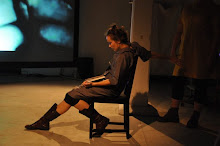
The Wooster Group's Vieux Carré is currently playing at the Baryshnikov Arts Center (inconveniently located just west of Times Square). The space is undergoing serious reconstruction -- the elevator only sometimes works, the floor of the main lobby contains about a hundred broken-down cardboard boxes -- and you will feel either like you're walking into a construction zone, or a performance art piece tricked out to resemble a construction zone.
I rarely walk out of a theater work with an unclear reaction to what was going on, but last night left me feeling a little confused. The piece is an adaptation of Tennessee Williams's Vieux Carré, not Williams's best or most interesting play. Add to that the fact that it's already pretty difficult in the present day to present Tennessee Williams unironically anyway. But that appears to have been precisely what the Wooster Group was after. Williams's language is oh so of a moment in history (squalid and poor as hell 1930s New Orleans artistic/gay underworld) and thus can only feel irredeemably stuck in that period, like a string of floating epigrams that stick in the throats of the actors struggling with them. The Wooster Group takes this already existing fact about the play and makes it more so -- the text floats around in chunky bits, a dialogue for lost souls who are hardly hearing one another, or hardly hearing themselves. At best, the result is a delicate quality of tragic self-alienation that makes recourse to a bygone, indirect communication because direct communication just isn't adequate to conveying the complex misery of life. At worst, it's simply parodic. The black maid who drifts in and out of scenes is made to speak in a terrible California Valley girl accent that clashes with Williams's dialect. Like, duh: he done fell down those stairs again, Miss!
Which isn't to say the emotional import of the language is entirely lost from the Wooster play. The characterizations sometimes border on caricature (as with the maid) but all of the roles are so brilliantly acted that even amid the distracting, post-apocalyptic, signature Wooster stage mess, their portrayals seem forced not because of what divides 2012 New York from 1930 New Orleans but for reasons that have to do with self-denial, with the closeted and schizophrenic alienation of these characters from themselves. Add to this the fact that each of the main characters plays multiple characters and is thus in a sense literally schizophrenic. The jerk carnival barker also plays the flamboyant, consumptive queen; the half-blind old mistress of the house is also the not so young anymore Blanche Dubois type living on the second floor. The production and the performers who move it along are all very impressive: the TVs flickering, costumes flying, and entrances and exits timed within a fraction of a second to sound and light cues, voiceovers and projections... But in this case, while it was easy to admire the facility of the operations involved in mounting the show, I'm still not sure what the show underlying all the technical wizardry was actually about. Which is to say, while I'm quite sure I saw a technological masterpiece, I'm not sure what message--however fraught or unstable--that masterpiece was designed to serve. And if there wasn't one, then it was a beautifully wrought frame with absolutely nothing in the center of it.
Which isn't to say there's anything wrong with this. My companion last night, Alexander Overington, is someone who unlike me fully appreciated the technical gadgetry at work and we stuck around post-show to chat up the three men at the rear of the stage sitting at a high table outfitted with Macbooks enough to run the mainframe of the Matrix. From what little I understood of their conversation, which was Greek to me ("...which is where my outboard is connected to Ted's inboard...and he's running the old version of OS9XLS...yeah, exactly, the rear-mounted widescreen feedback loop is wired into the smallscreen mounted on the rear projector...."), their contribution to the show was nothing short of dazzling.
Sunday, February 27, 2011

Saturday, February 26, 2011
Sheer Genius
Can someone help me find this man? Thanks to a tip from my little bro, I am on a mission to commission Reggie Watts to write an opera for me. The world will be a better place with a Reggie Watts opera in it.
Help. Me. Find. Him.
Help. Me. Find. Him.
Wednesday, February 23, 2011
ICE at Alice Tully
The International Contemporary Ensemble, which I've often bragged about, did a number on Alice Tully Hall last night. I myself score appallingly low on the new music aficionado spectrum (I only recently learned how to pronounce Rzewski) so I had a considerably puffed up attitude last night when I discovered I actually knew all the composers on the program, which were:
Morton Feldman (1926-1987): The King of Denmark (1964) for solo percussion
The obvious crowd-pleaser in the group is the Cage piece, which I imagine made most of last night's audience feel nostalgic, but which will never go out of style, because doing low-brow things in high-brow spaces will always be funny. Think of the Marx Brothers. The Cage piece makes high art out of channel surfing. Any number of pairs of musicians stand on stage, and each pair shares a little ham radio (last night there were about 10). One musician is in charge of the channel dial, and the other the volume dial. The fun part is that all of this randomness (the fact that you can never know whether your radio is about to blare out Third Eye Blind or Verdi) is exactingly controlled by the prescribed length of time allotted for each outburst (we hear exactly one and a half bars of "Stairway to Heaven" followed by one beat of deafening silence). So it's at once a fancy, serious new music piece ... and it's also pretty goofy.
Speaking of music and goofy, some degree of ink has been spilled in musicology over the question of what constitutes humor in music and why we find music funny at all, when we do. The age old example is Haydn's "Joke" quartet, where the composer endears the audience by toying with the impulse to clap at the end of a piece. He stops. And we start to clap. And then he starts again. It's funny because Haydn calls our bluff. "The rests get progressively longer, giving the impression that the piece is over many times in a row, making for an amusing ending." Um, thanks, Wikipedia!
But then come Xenakis's Jalons, during which I several times last night had to smother my own laughter with a laugh-cough (which is definitely not a laugh, but only a cough that briefly -- whoops! -- sounds like a laugh). Xenakis is a genius of the musical joke and Jalons a litany of every possibility for extracting humor out of variations in volume, rhythm, and audience expectation.
Favorite moment on the program: Steve Schick's extremely sexy rendition of Feldman's King of Denmark. If you thought Feldman wasn't sexy, think again.
Morton Feldman (1926-1987): The King of Denmark (1964) for solo percussion
Anton Webern (1883-1945): Konzert op.24 (1934) for nine instruments
Iannis Xenakis (1922-2001): Jalons (1986) for chamber orchestra
John Cage (1912-1992): Imaginary Landscape No. 4 (1951) for 24 performers and 12 radios
Feldman: For Samuel Beckett (1987) for chamber orchestra
The obvious crowd-pleaser in the group is the Cage piece, which I imagine made most of last night's audience feel nostalgic, but which will never go out of style, because doing low-brow things in high-brow spaces will always be funny. Think of the Marx Brothers. The Cage piece makes high art out of channel surfing. Any number of pairs of musicians stand on stage, and each pair shares a little ham radio (last night there were about 10). One musician is in charge of the channel dial, and the other the volume dial. The fun part is that all of this randomness (the fact that you can never know whether your radio is about to blare out Third Eye Blind or Verdi) is exactingly controlled by the prescribed length of time allotted for each outburst (we hear exactly one and a half bars of "Stairway to Heaven" followed by one beat of deafening silence). So it's at once a fancy, serious new music piece ... and it's also pretty goofy.Speaking of music and goofy, some degree of ink has been spilled in musicology over the question of what constitutes humor in music and why we find music funny at all, when we do. The age old example is Haydn's "Joke" quartet, where the composer endears the audience by toying with the impulse to clap at the end of a piece. He stops. And we start to clap. And then he starts again. It's funny because Haydn calls our bluff. "The rests get progressively longer, giving the impression that the piece is over many times in a row, making for an amusing ending." Um, thanks, Wikipedia!
But then come Xenakis's Jalons, during which I several times last night had to smother my own laughter with a laugh-cough (which is definitely not a laugh, but only a cough that briefly -- whoops! -- sounds like a laugh). Xenakis is a genius of the musical joke and Jalons a litany of every possibility for extracting humor out of variations in volume, rhythm, and audience expectation.
Favorite moment on the program: Steve Schick's extremely sexy rendition of Feldman's King of Denmark. If you thought Feldman wasn't sexy, think again.
Wednesday, December 15, 2010
More food for Paul please
It has come to my attention that one of my best friends recently started blogging. All the names are changed, but if you know this guy's appetitive qualities, you'll recognize him right off the bat. (Blogger is telling me appetitive is not a word. Guess what, Blogger: you should be embarrassed for yourself.) This is a person who texted me a few days ago just to tell me he was about to sit down to eat a pastrami sandwich. My friend, a.k.a. Paul, does not just enjoy eating. The thought of incoming food makes him want to talk about it. Which is why I'm glad he's finally blogging.
Check it out.
Check it out.
Friday, November 26, 2010
Thanksgiving Highlights
1. Mom and grandma lecture my youngest brother, Greggie, on attracting lady friends.
2. Turkey inspires existential reflection in the living room.
3. My mother ruins a perfectly good game of charades (in this stunningly well-played performance by my ultratalented actor cousin, James Safarik).
2. Turkey inspires existential reflection in the living room.
3. My mother ruins a perfectly good game of charades (in this stunningly well-played performance by my ultratalented actor cousin, James Safarik).
Thursday, November 25, 2010
Family Resemblances
One midwinter eve a long, long time ago, my mother was putting me down for the night, and when I slipped into bed, an enormous, dark cockroach slid out from under the bed covers and made a beeline (roachline) for my 5-year old butt. My mother is squeamish about a lot of things -- violence, Southpark, family secrets, talking about sex, learning new things -- but she is unmoved by the creeping, crawling things of the earth. The cockroach never made it to my rear end because it ended its life between her thumb and forefinger.
Today, my mother has Boxelder bugs that live in the warm sunlight of the living room.

Contrary to what you might imagine, Boxelder bugs are not attracted to Boxelder trees. They're attracted to my mother. They end their lives in our garbage disposal.
My mother and I are dissimilar in certain ways. I can't kill anything with my bare hands, for instance. At home in Princeton, I have a disoriented, starving squash bug who lives on the watering can and who I don't have the heart to get rid of. My mother tans easily and loves the outdoors; I have vampirically white skin and spend a lot of time in libraries. My mother loves children and is very tolerant of them. I am not interested in children and 'tolerant' is not a word people use to describe me. My mother is easily intimidated by other people and sensitive to their needs. I am selfish and inflexible and have no patience for people who need things. But as I sit here on Thanksgiving day watching her forget to put the sugar in the pumpkin pie, I'm reminded of the fact that I forgot to use soap in the shower last night. (Don't ask.) My mother and I were also last night's evening entertainment, she did a hula dance for me, my youngest brother, and my dad; I fell face first out of a reclining chair while my father took pictures.
It's not that I would actually want to change anything about the things we share or don't share, with the possible exception of my mother's legs, which we don't share, and which I wish we did. (If you ever get the chance to see them, my mother has marvelous legs.) I just want to know what it means if I am in fact turning into my mother. Wouldn't it mean that as I watch my mother move 14 house plants from the window sill to the kitchen sink (?) I'm actually watching myself, in the future, doing inexplicable things with the houseplants? Doesn't it mean I and not she just baked an inedible, sugarless pumpkin pie? That I wake up at 5am (which, dammit, I already do), that I'm humming the same effing Gilbert & Sullivan song for the third day in a row, and carrying on about turning into my mother? I guess I have that one covered, too.
Then again, as I look at my dad biking in the middle of the living room in knee-high black socks and neon green shorts ... it could be worse.
Today, my mother has Boxelder bugs that live in the warm sunlight of the living room.

Contrary to what you might imagine, Boxelder bugs are not attracted to Boxelder trees. They're attracted to my mother. They end their lives in our garbage disposal.
My mother and I are dissimilar in certain ways. I can't kill anything with my bare hands, for instance. At home in Princeton, I have a disoriented, starving squash bug who lives on the watering can and who I don't have the heart to get rid of. My mother tans easily and loves the outdoors; I have vampirically white skin and spend a lot of time in libraries. My mother loves children and is very tolerant of them. I am not interested in children and 'tolerant' is not a word people use to describe me. My mother is easily intimidated by other people and sensitive to their needs. I am selfish and inflexible and have no patience for people who need things. But as I sit here on Thanksgiving day watching her forget to put the sugar in the pumpkin pie, I'm reminded of the fact that I forgot to use soap in the shower last night. (Don't ask.) My mother and I were also last night's evening entertainment, she did a hula dance for me, my youngest brother, and my dad; I fell face first out of a reclining chair while my father took pictures.
It's not that I would actually want to change anything about the things we share or don't share, with the possible exception of my mother's legs, which we don't share, and which I wish we did. (If you ever get the chance to see them, my mother has marvelous legs.) I just want to know what it means if I am in fact turning into my mother. Wouldn't it mean that as I watch my mother move 14 house plants from the window sill to the kitchen sink (?) I'm actually watching myself, in the future, doing inexplicable things with the houseplants? Doesn't it mean I and not she just baked an inedible, sugarless pumpkin pie? That I wake up at 5am (which, dammit, I already do), that I'm humming the same effing Gilbert & Sullivan song for the third day in a row, and carrying on about turning into my mother? I guess I have that one covered, too.
Then again, as I look at my dad biking in the middle of the living room in knee-high black socks and neon green shorts ... it could be worse.
Saturday, October 16, 2010
Princeton Vuja De
When I was in college, my father told me he wouldn't go back to college for a million dollars. At the time, I thought, "well that's dumb!" Cause college is great, right? Well, college is great, when you're in college. When you're not in college anymore, you're just not in college anymore.
There are things that happen over and over again, like heading to the bathroom to eat snacks in private, and there are thing that don't happen again. College is like getting a polio vaccine or seeing Haley's comet. It only happens once in your lifetime.
Correction: twice! About six weeks ago, I moved back to Princeton, my alma mater. At the time, it didn't seem insane. (There were good reasons, too, which I won't go into here, but one of which is the proximity to New York without the New York rent. There have also been unanticipated perks like the fact that I have yet to fill up my gas tank. The only time I didn't have to fill up my gas tank in Chicago was when I didn't have a gas tank.) But, as it turns out, the move is making me a little insane. I keep having this strange feeling I've been here before.
At the end of Thorton Wilder's Our Town, the main character, Emily, is given a chance to relive a single day from her past. (I forgot to mention, she's dead.) The other folks in the graveyard tell her to pick a slow day--a day when nothing happened. Because to pick a really amazing day, like the day you fell in love, would be psychically damaging, like looking at photographs of someone who died and then seeing them appear in front of you. Emily picks her 12th birthday, and she lasts about 90 seconds. She hears her mother's voice and has to call the whole thing off. Don't relive your 12th birthday.
Every day I walk out onto University Place, and every day I think, What in God's Name is Happening Here? I think I see my old friends. Is that Todd on his bike? Cindy on the Erg machine? The same tan flock of men's cross-country runners blows by in the morning. The word I'm looking for is déjà vu, except you can't have déjà vu at the same time every day unless you wake up every morning having forgotten yesterday. Déjà vu is a feeling of compelling familiarity in a situation that hasn't actually happened before. What I'm having is a feeling of compelling familiarity in a situation where I have a pretty good idea why it's familiar. So why's it creepy?
For one, I've never had déjà vu. I tell people this and they don't believe me, but it's true. I would kill to have déjà vu. There's also (hilariously enough) presque vu (which is the sensation of being just on the verge of recovering a latent memory--when something is on the tip of your tongue) and jamais vu, which is seeing something familiar as though it were brand new. This is the bizarre experience I often have of catching sight of my reflection in a shop window and thinking it's my mother.
I think the word I want is vuja de. But then, it turns out, vuja de already has a meaning. (WTF?) According to the Urban Dictionary, vuja de is the feeling of definitely never having been somewhere before. To me, that's lame. I have that feeling all the time and it's not worthy of having a name. I'm gonna keep using vuja de my way.
Vuja de: the feeling you relive every day that you knew you were getting into something vaguely dumb, and you went ahead and did it anyway.
There are things that happen over and over again, like heading to the bathroom to eat snacks in private, and there are thing that don't happen again. College is like getting a polio vaccine or seeing Haley's comet. It only happens once in your lifetime.
Correction: twice! About six weeks ago, I moved back to Princeton, my alma mater. At the time, it didn't seem insane. (There were good reasons, too, which I won't go into here, but one of which is the proximity to New York without the New York rent. There have also been unanticipated perks like the fact that I have yet to fill up my gas tank. The only time I didn't have to fill up my gas tank in Chicago was when I didn't have a gas tank.) But, as it turns out, the move is making me a little insane. I keep having this strange feeling I've been here before.
At the end of Thorton Wilder's Our Town, the main character, Emily, is given a chance to relive a single day from her past. (I forgot to mention, she's dead.) The other folks in the graveyard tell her to pick a slow day--a day when nothing happened. Because to pick a really amazing day, like the day you fell in love, would be psychically damaging, like looking at photographs of someone who died and then seeing them appear in front of you. Emily picks her 12th birthday, and she lasts about 90 seconds. She hears her mother's voice and has to call the whole thing off. Don't relive your 12th birthday.
Every day I walk out onto University Place, and every day I think, What in God's Name is Happening Here? I think I see my old friends. Is that Todd on his bike? Cindy on the Erg machine? The same tan flock of men's cross-country runners blows by in the morning. The word I'm looking for is déjà vu, except you can't have déjà vu at the same time every day unless you wake up every morning having forgotten yesterday. Déjà vu is a feeling of compelling familiarity in a situation that hasn't actually happened before. What I'm having is a feeling of compelling familiarity in a situation where I have a pretty good idea why it's familiar. So why's it creepy?
For one, I've never had déjà vu. I tell people this and they don't believe me, but it's true. I would kill to have déjà vu. There's also (hilariously enough) presque vu (which is the sensation of being just on the verge of recovering a latent memory--when something is on the tip of your tongue) and jamais vu, which is seeing something familiar as though it were brand new. This is the bizarre experience I often have of catching sight of my reflection in a shop window and thinking it's my mother.
I think the word I want is vuja de. But then, it turns out, vuja de already has a meaning. (WTF?) According to the Urban Dictionary, vuja de is the feeling of definitely never having been somewhere before. To me, that's lame. I have that feeling all the time and it's not worthy of having a name. I'm gonna keep using vuja de my way.
Vuja de: the feeling you relive every day that you knew you were getting into something vaguely dumb, and you went ahead and did it anyway.
Subscribe to:
Posts (Atom)