Two years ago I got trapped in International Terminal at O'Hare on an empty stomach. Not knowing any better, I had swept past security and into the terminal only to discover that there was no food there. I don't mean there's no good food (and hence I'd eaten a half-smashed Snickers before boarding and felt nauseous for eight hours....) No, I mean there is literally no food. The international wing at O'Hare is the only place on American soil where there are no vending machines. There is one fold-out, painted plywood box from a third world bazaar, with a couple neat rows of disposable cameras and Advil 2-packs, and its vendor goes home at 8pm.
Today, I mosey up to the man guarding the first set of security stops and offer him my ticket. He says, Have you eaten? (Who is this guy? Do I look hungry?) I point to the sign leading down the terminal that says "SNACKS." He says, If you haven't eaten, go back. NO SNACKS IN THE INTERNATIONAL TERMINAL. Duh! How could I have forgotten? Solo travel rule number one: bring your own snacks. Do not rely on the concerns of the international wing on behalf of its travelers. It doesn't care about you.
Thursday, March 18, 2010

Sunday, March 7, 2010
The Unperformance of Fitness in Ratner Gymnasium
A couple years ago I blogged about the strange fashion I saw in Berlin's women-only gyms. According to a similar logic that enables female fashion in eastern Nebraska to lockstep one decade behind the times (if in the late eighties women were doing this with their hair

in Papillion, Nebraska, they were still doing it when I went to college in 1997) Berliners still lift weights in thong aerobics leotards. But in both of these cases, I have to assume that these fashion choices are choices. (Someone took the time to make a decision and follow it through.) Maybe they're misguided, maybe they're slow. But they're still deciding: this looks good on me. I'll take it!
On the other hand, the fashion cluelessness at the University of Chicago is just that--complete unconsciousness. And I mean fashion not only in the sense of what one wears (pocket protectors, hair nets, coke-bottle glasses) but as comportment generally (how one walks, talks, poses, assumes an attitude). In short, if fashion = the sum of all the choices that go into determining how one's body is presented to the world, in this case, fashion = 0. (I'm not sure that was actual math.)
One has to assume that the students here are simply too overworked (under-exercised), overstimulated (caffeine replacements) or underexposed (to other human beings?) to think about what they're doing with their bodies at all. (What, commit myself to conscious action when I get dressed in the morning? You must be crazy! I have to get to the bottom of Lacan's &<>$!!) This might make the U of C the one place on earth apart from Moore's utopia where everyone might as well be wearing unisuits because what they're wearing conveys exactly the same information as a unisuit: "what I'm wearing is of no consequence; it is not integral to who I am." But of course, it's entirely integral to who we are, because if we care not at all for what we wear, that says a great deal about our attitude toward our bodies. It says my body is beside the point.
Case in point? Back to Ratner. I'll give a quick run-down of my choicest choices.
There's Speedo, the guy with a military haircut and a vigorous ballet routine who drags his "girlfriend" to the gym and then stares at his crotch in the mirror for 45 minutes while doing every exercise that involves legs spread apart. There's Thirsty, who needs to drink at least once a minute, who gets perceptibly nervous when anyone else tries to use the drinking fountain, and who has difficulty navigating space with other bodies in it. (About a week ago, Thirsty threw himself down onto the ground 3 inches from my right elbow, did 10 crunches, noticed someone at the fountain, sprung to his feet, and nearly crushed my skull. I don't pity these folks. Self-absorption & stupidity in one case, obliviousness and a possible proprioceptive injury in another, do not trouble me. But then there's Priceless, the woman who looks like she escaped from the exotics wing of the Salpêtrière who walks up and down the hallway ... sideways. With a book. And today, a man pedaled a stationary bike so violently that it hobbled like a bouncing laundry machine all the way into the center of the gym and straight into the triceps dip station. I think I'll call him Time to Finish My Dissertation.

in Papillion, Nebraska, they were still doing it when I went to college in 1997) Berliners still lift weights in thong aerobics leotards. But in both of these cases, I have to assume that these fashion choices are choices. (Someone took the time to make a decision and follow it through.) Maybe they're misguided, maybe they're slow. But they're still deciding: this looks good on me. I'll take it!
On the other hand, the fashion cluelessness at the University of Chicago is just that--complete unconsciousness. And I mean fashion not only in the sense of what one wears (pocket protectors, hair nets, coke-bottle glasses) but as comportment generally (how one walks, talks, poses, assumes an attitude). In short, if fashion = the sum of all the choices that go into determining how one's body is presented to the world, in this case, fashion = 0. (I'm not sure that was actual math.)
One has to assume that the students here are simply too overworked (under-exercised), overstimulated (caffeine replacements) or underexposed (to other human beings?) to think about what they're doing with their bodies at all. (What, commit myself to conscious action when I get dressed in the morning? You must be crazy! I have to get to the bottom of Lacan's &<>$!!) This might make the U of C the one place on earth apart from Moore's utopia where everyone might as well be wearing unisuits because what they're wearing conveys exactly the same information as a unisuit: "what I'm wearing is of no consequence; it is not integral to who I am." But of course, it's entirely integral to who we are, because if we care not at all for what we wear, that says a great deal about our attitude toward our bodies. It says my body is beside the point.
Case in point? Back to Ratner. I'll give a quick run-down of my choicest choices.
There's Speedo, the guy with a military haircut and a vigorous ballet routine who drags his "girlfriend" to the gym and then stares at his crotch in the mirror for 45 minutes while doing every exercise that involves legs spread apart. There's Thirsty, who needs to drink at least once a minute, who gets perceptibly nervous when anyone else tries to use the drinking fountain, and who has difficulty navigating space with other bodies in it. (About a week ago, Thirsty threw himself down onto the ground 3 inches from my right elbow, did 10 crunches, noticed someone at the fountain, sprung to his feet, and nearly crushed my skull. I don't pity these folks. Self-absorption & stupidity in one case, obliviousness and a possible proprioceptive injury in another, do not trouble me. But then there's Priceless, the woman who looks like she escaped from the exotics wing of the Salpêtrière who walks up and down the hallway ... sideways. With a book. And today, a man pedaled a stationary bike so violently that it hobbled like a bouncing laundry machine all the way into the center of the gym and straight into the triceps dip station. I think I'll call him Time to Finish My Dissertation.
Tuesday, February 23, 2010
Opera Cabal and Time Travel
Opera Cabal's final performance of USW sold out Galapagos Art Space last night. Due to some last minute tinkering (on a whim, Alex & I ordered a giant 7X10 screen that hung under the disco ball in the center of the space and looked like one of those awesome LCD display screens at the Super Bowl, plus Habib jerry-rigged the onstage scrim to sweep up and down like a massive sail, and the bartenders dyed the water under the audience's seats black, the better to reflect all the projections in the piece) the show was, in short, spectacular. Yesterday I didn't like New Yorkers. Today, I'm in love with them.
From a personal standpoint, I highly recommend doing something interesting enough that people you haven't seen in half a lifetime are tempted to come and hang out to see it. I thought I'd died and gone to heaven yesterday -- but literally. Every 10 seconds someone I hadn't seen in between 5 and 12 years walked past me and then we recognized each other ... and then had nothing to say. Excellent!
Things that don't change in a city that is otherwise always changing:
I hit up the Verb café in Williamsburg this morning, an old haunt of mine from 2005. Back in the day, when most other coffee houses, especially hip, progressive ones like the Verb (started by the man who married the girl who played the crazy pretty princess in The Neverending Story) were sporting fancy hi-speed wireless internet access, to get internet at the Verb you had to walk out of the cafe and down a weird, slightly deserted hallway to this grungy little tech hole called the internet garage to buy -- in person -- a faded little internet day pass (User Name: BH#cInQ$3h, Password: IcY*007) that didn't even work 60% of the time. It was very 1998 in 2005. In 2010, lo and behold, the internet garage is still there, and you still have to walk back in time and give your paper money to Marty McFly to be able to use the internet. In spite of this, to all you friends of mine who pooh-pooh Williamsburg and refuse to go there anymore because it's so developed, GET OVER IT. New York will always be developing. Williamsburg is awesome, even with all the strollers, and there is no competition for the runny oatmeal at the Verb.
From a personal standpoint, I highly recommend doing something interesting enough that people you haven't seen in half a lifetime are tempted to come and hang out to see it. I thought I'd died and gone to heaven yesterday -- but literally. Every 10 seconds someone I hadn't seen in between 5 and 12 years walked past me and then we recognized each other ... and then had nothing to say. Excellent!
Things that don't change in a city that is otherwise always changing:
I hit up the Verb café in Williamsburg this morning, an old haunt of mine from 2005. Back in the day, when most other coffee houses, especially hip, progressive ones like the Verb (started by the man who married the girl who played the crazy pretty princess in The Neverending Story) were sporting fancy hi-speed wireless internet access, to get internet at the Verb you had to walk out of the cafe and down a weird, slightly deserted hallway to this grungy little tech hole called the internet garage to buy -- in person -- a faded little internet day pass (User Name: BH#cInQ$3h, Password: IcY*007) that didn't even work 60% of the time. It was very 1998 in 2005. In 2010, lo and behold, the internet garage is still there, and you still have to walk back in time and give your paper money to Marty McFly to be able to use the internet. In spite of this, to all you friends of mine who pooh-pooh Williamsburg and refuse to go there anymore because it's so developed, GET OVER IT. New York will always be developing. Williamsburg is awesome, even with all the strollers, and there is no competition for the runny oatmeal at the Verb.
Saturday, February 13, 2010
Opera Cabal rehearses USW in Oberlin
In preparation for a move to Chicago (February 19 & 20) and NYC (February 22), Opera Cabal spent the last week rehearsing its newest work, USW, here in snowy Oberlin. USW was commissioned and written by & for Opera Cabal in 2008 by Lewis Nielson, chair of composition at Oberlin Conservatory. We spent the summer workshopping the piece at High Concept Laboratories (one of Kevin Simmons' many projects) and are now putting on the finishing touches.
Some photos from the production process this winter, c/o Kevin Simmons...

Me, playing Rosa Luxemburg.

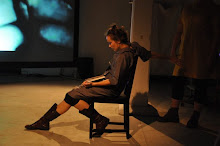
Sarah Kozinn, our new actress, cowering next to the newly-built chair.

Me, trapped behind the scrims.

Chair building.

Me & Sarah: hair-pulling (yes, these things are ALL in the show).
And finally, our creative team, from left: Habib Azar, director; Sarah Kozinn; Lewis Nielson; me, floor; and Molly Feingold, assistant director.

Some photos from the production process this winter, c/o Kevin Simmons...

Me, playing Rosa Luxemburg.

Sarah Kozinn, our new actress, cowering next to the newly-built chair.

Me, trapped behind the scrims.

Chair building.

Me & Sarah: hair-pulling (yes, these things are ALL in the show).
And finally, our creative team, from left: Habib Azar, director; Sarah Kozinn; Lewis Nielson; me, floor; and Molly Feingold, assistant director.

Friday, February 5, 2010
Peter Maxwell Davies in NYC
I left for New York at the beginning of the week intending to interview Peter Maxwell Davies (whose mid-century, incendiary works for theater are the subject of my dissertation). (BD, I have you alone to thank for this. You know who you are :) In 1969, Davies left Manchester and retreated, literally, to the Orkney Islands, where he now lives with his partner, Colin Parkinson. Instead of interviewing Davies, I spent two hours talking to the two of them about Orkney -- Davies' cow, who lives with them, is affectionate & pliable and stays with the neighbors when its two dads are out of town. Colin owns goldfish that are a foot long, and nearly twenty years old. Both have eaten swan. No one in Orkney locks his doors at night, and Davies has been known to wander into neighbors' houses to make himself a sandwich.
But it's not as if any of this is incidental to Davies' career, which is overwhelmingly public -- apart from being Master of the Queen's Music, Davies' Orkney Island Festival has attracted the likes of André Previn and Vladimir Ashkenazy. Rather, Davies' career is a remarkable instance of how to disappear completely and still remain in the public eye. I, being very much the perpetual traveler due to all this Opera Cabal fuss, spend inordinate amounts of time with inordinate numbers of people & in the intervals when I'm not, feel like climbing into bed with a shot glass and noise-canceling headphones. Davies has managed to strike a balance. When he's not jet-setting across the Atlantic or meeting disorganized graduate students in music, he's chilling with a cow, a couple of goldfish and a sunset (and, of course, the company of a compulsive urge to compose). But the two clearly enable one another. It's time to move to Orkney.
But it's not as if any of this is incidental to Davies' career, which is overwhelmingly public -- apart from being Master of the Queen's Music, Davies' Orkney Island Festival has attracted the likes of André Previn and Vladimir Ashkenazy. Rather, Davies' career is a remarkable instance of how to disappear completely and still remain in the public eye. I, being very much the perpetual traveler due to all this Opera Cabal fuss, spend inordinate amounts of time with inordinate numbers of people & in the intervals when I'm not, feel like climbing into bed with a shot glass and noise-canceling headphones. Davies has managed to strike a balance. When he's not jet-setting across the Atlantic or meeting disorganized graduate students in music, he's chilling with a cow, a couple of goldfish and a sunset (and, of course, the company of a compulsive urge to compose). But the two clearly enable one another. It's time to move to Orkney.
Rebekah Heller in concert
As if I needed further evidence of the superiority of the I.C.E. musicians, not only as musicians, but also as human beings, enter Rebekah Heller.* I heard Rebekah, a bassoonist, last week in a private concert along with fellow I.C.E.'er William McDaniel (piano) that included works by Vivaldi, Edgar Guzman (a special 2008 commission that called for amplified bassoon, coordinated with live tape loop), Gubaidulina and Astor Piazzolla.
It was an exemplary concert in every conceivable way. I'm obviously a fan of intimate spaces and here there was intimacy to spare. I'm also a fan of performers who not only know how to speak about complicated music in uncomplicated ways, but can do so and disarm their audience in the process. And the programming was superb -- if I may attempt to package and resell the effectiveness of the arc of the evening's concert for my fellow musicians:
Start with 1 something that shows off a technical & lively command of the instrument, followed by 2 a total contrast, in this case the arresting quality of VERY new music, followed by 3 an emotionally unchecked outpouring of virtuosity and, then 4 end with tango, because it's just awfully sexy.
*Don't believe me? Check out the dueling oboes concert at MoCP next Friday, February 12. And don't get there late, because you may not get in.
It was an exemplary concert in every conceivable way. I'm obviously a fan of intimate spaces and here there was intimacy to spare. I'm also a fan of performers who not only know how to speak about complicated music in uncomplicated ways, but can do so and disarm their audience in the process. And the programming was superb -- if I may attempt to package and resell the effectiveness of the arc of the evening's concert for my fellow musicians:
Start with 1 something that shows off a technical & lively command of the instrument, followed by 2 a total contrast, in this case the arresting quality of VERY new music, followed by 3 an emotionally unchecked outpouring of virtuosity and, then 4 end with tango, because it's just awfully sexy.
*Don't believe me? Check out the dueling oboes concert at MoCP next Friday, February 12. And don't get there late, because you may not get in.
Friday, January 8, 2010
Bluebeard at the CSO, and how about that ending?
Something is not quite right about Bluebeard's Castle. Following the production of the opera-ette back at the Harris Theater in 2007 (dir. Ken Cazan, although the credit for pairing Bluebeard along with Erwartung goes to COT director, Brian Dickie) I blamed it all on Cazan (KAZAAN!). In the final moments of the opera, three brightly-colored ladies in gauzy Bollywood outfits mince out of a little cellar (in Cazan's version, the doors Judith insists on opening are, for no particular reason except that they're probably cheaper to build, trap doors) and dance a sad little dance around Judith before pushing her down the steps and flouncing in after her. It's not scary, it's not thought-provoking, it's just plain strange. Last night at the CSO, I realized it wasn't all Cazan's fault.
What makes an opera? In this case, it's all about redundancy of information. Bluebeard broadcasts well in advance how things are going to turn out. And, in addition to being highly redundant and slow-moving, Bluebeard is also scary, which makes for an awkward combination, but also makes the opera more like a scary movie. We know, or at least we imagine we know, that Bluebeard is a homicidal maniac and that Judith, being silly enough to run off with him, bless her heart, is about to get herself chopped up for dogmeat. But the only thing that actually happens for the duration of evening is that Judith will seven times override Bluebeard's request that she not open a set of seven doors in his castle and that, gradually, each of the doors will come open. The suspense centers on two things. One: the mystery of what in God's name Bluebeard has hidden up in his weird old bachelor pad, and the fact that Judith will insist on opening up every single one of his doors (euphemism?) until something really, really bad happens. (Yippee!) Two, and this is the one I wanna talk about, because I think it's where Bartok misjudged things: the impenetrability of Bluebeard as a character. We can't get a read on him. Does he love Judith? Why does she love him? Is it the beard? It seems possible, if unlikely, that our suspicions about Bluebeard are wrong. Sure, he lives all by himself in a scary old castle ... but it's not because he's a crazy psychokiller ... he's just really different, and maybe a little depressed (and what woman wouldn't love that?) Bluebeard rises and falls on Bluebeard's indecipherability. If we knew what was really going on behind that massive beard, we wouldn't have to spend all night guessing, but we don't, so we do.
Up until the final moments of the opera, Bartok successfully drags out a plotline in which almost nothing happens, but it's just the right of something to keep us on the edge of our seats. Doors are unlocked at a painfully slow rate; we're waiting patiently to get to the last one, the one that really matters. We're willing to wait because we assume, and hope, that something terrible will happen when Bluebeard finally loses his cool: Judith will insist on unbolting that final, fateful door, she'll be murdered in cold blood and the curtain will come ringing down. (Judith, it must be said, could have avoided her own death simply by not being such a terrible nuisance about the doors* and then Bartok might have left the last door locked for eternity, leaving us to imagine what might have been there, a device which, as we know from scary movies, works wonders. Aliens are always scarier before we actually see them.)
But when Judith insists on unbolting the final door and finds herself in the company of Bluebeard's other undead wives, Bluebeard does exactly nothing. He doesn't lose it. He doesn't fall down weeping. He just stands there. Suddenly, the suspense upon which the opera depended (our worry or hope that Bluebeard will turn out to be a raving madman and that Judith will die a horrible death) is made to seem rather silly. Unless we have reason to believe that Bluebeard is, despite his apparent love for Judith, a total maniac, the entire story falls apart--and in the end, when we find out he's not, or at least that he's more Henry Darger crazy than Clockwork Orange crazy, it does. To complete the disappointment, Judith simply accompanies the other women back into the wardrobe of eternal boredom. We get no fits, no screaming, no temper tantrums, no aria of regret, and worst of all, no death. Bartok's crucial misstep in an opera that is otherwise pretty fabulous (hey, it's short!) is an ending that offers neither the excitement of blood and gore and the confirmation of Bluebeard's truly psychotic nature, nor a reversal in which everything is turned upside down and Bluebeard is revealed as a man of exemplary character. (Hey, it happens: ever see Beauty and the Beast?) Instead, Bluebeard turns out to be crazy lite and the opera can't decide if it's a tragedy or a comedy (on the aspect of comedy, some of the dialogue between Judith and Bluebeard ["I want to open the door." "No, you can't open the door." "Open it, open it!" "No, no!"] is highly reminiscent of stand-up comedian Billy Connolly's take on opera). In a choose your own adventure of endings, Bluebeard makes all the most uninteresting choices. Bluebeard neither triumphs nor is he redeemed. He walks away, logs wife #4 in his diary and takes a nap. There's no bloodbath for Judith, and of course, she can't escape. She holes up in a cupboard to trade sad stories with a bunch of other slightly stupid women.
On last night's performance: I don't generally like concert stagings and I like concert performances even less, but Michelle DeYoung, last night's Judith, did a spectacular job of turning the concert performance prohibition on wandering around the stage into a dramatic strength. She looked as though she'd been nailed to the floor. It was spooky. Bluebeard, Falk Struckmann, on the other hand, couldn't have been less disarming. His glances across the stage at Judith seemed motivated by uncertainty (did I just hear a fart?) or maybe boredom (why is she still singing!?) And the CSO, while plaintive and tinny with its Ravel earlier in the evening, totally smothered the poor singers. Maybe Boulez needs an earhorn. Or maybe light travels faster than sound in that hall. There's a marvelous moment mid-Bluebeard where Judith opens the door to Bluebeard's enormous, vast kingdom and she's so overwhelmed that all she can do is belt out a huge, loud, sustained high C. Last night, Michelle's mouth came unhinged at the appropriate point, but all she managed was a silent scream. For a second I thought she was miming ... oh, my bad, that was the high C.
*Poor Judith's treachery is unenviable--for her to prove good on her word, i.e. not to ask what's behind the doors, would derail the unfolding of the plot so she must for dramatic reasons have a weakness for spoiling a good secret. Wagner understood the usefulness of such a predicament, since without Elsa's betrayal of Lohengrin in the final hour, the two would be fated to live happily ever after with an enormous elephant in the room (who in God's name she actually married). Instead, Elsa is forced to understand how entirely she's blown it, learning (what we knew already!) that her husband is not only an extremely good fighter, but the holiest bachelor in all of Brabant, but only at the moment she's lost him for good.
What makes an opera? In this case, it's all about redundancy of information. Bluebeard broadcasts well in advance how things are going to turn out. And, in addition to being highly redundant and slow-moving, Bluebeard is also scary, which makes for an awkward combination, but also makes the opera more like a scary movie. We know, or at least we imagine we know, that Bluebeard is a homicidal maniac and that Judith, being silly enough to run off with him, bless her heart, is about to get herself chopped up for dogmeat. But the only thing that actually happens for the duration of evening is that Judith will seven times override Bluebeard's request that she not open a set of seven doors in his castle and that, gradually, each of the doors will come open. The suspense centers on two things. One: the mystery of what in God's name Bluebeard has hidden up in his weird old bachelor pad, and the fact that Judith will insist on opening up every single one of his doors (euphemism?) until something really, really bad happens. (Yippee!) Two, and this is the one I wanna talk about, because I think it's where Bartok misjudged things: the impenetrability of Bluebeard as a character. We can't get a read on him. Does he love Judith? Why does she love him? Is it the beard? It seems possible, if unlikely, that our suspicions about Bluebeard are wrong. Sure, he lives all by himself in a scary old castle ... but it's not because he's a crazy psychokiller ... he's just really different, and maybe a little depressed (and what woman wouldn't love that?) Bluebeard rises and falls on Bluebeard's indecipherability. If we knew what was really going on behind that massive beard, we wouldn't have to spend all night guessing, but we don't, so we do.
Up until the final moments of the opera, Bartok successfully drags out a plotline in which almost nothing happens, but it's just the right of something to keep us on the edge of our seats. Doors are unlocked at a painfully slow rate; we're waiting patiently to get to the last one, the one that really matters. We're willing to wait because we assume, and hope, that something terrible will happen when Bluebeard finally loses his cool: Judith will insist on unbolting that final, fateful door, she'll be murdered in cold blood and the curtain will come ringing down. (Judith, it must be said, could have avoided her own death simply by not being such a terrible nuisance about the doors* and then Bartok might have left the last door locked for eternity, leaving us to imagine what might have been there, a device which, as we know from scary movies, works wonders. Aliens are always scarier before we actually see them.)
But when Judith insists on unbolting the final door and finds herself in the company of Bluebeard's other undead wives, Bluebeard does exactly nothing. He doesn't lose it. He doesn't fall down weeping. He just stands there. Suddenly, the suspense upon which the opera depended (our worry or hope that Bluebeard will turn out to be a raving madman and that Judith will die a horrible death) is made to seem rather silly. Unless we have reason to believe that Bluebeard is, despite his apparent love for Judith, a total maniac, the entire story falls apart--and in the end, when we find out he's not, or at least that he's more Henry Darger crazy than Clockwork Orange crazy, it does. To complete the disappointment, Judith simply accompanies the other women back into the wardrobe of eternal boredom. We get no fits, no screaming, no temper tantrums, no aria of regret, and worst of all, no death. Bartok's crucial misstep in an opera that is otherwise pretty fabulous (hey, it's short!) is an ending that offers neither the excitement of blood and gore and the confirmation of Bluebeard's truly psychotic nature, nor a reversal in which everything is turned upside down and Bluebeard is revealed as a man of exemplary character. (Hey, it happens: ever see Beauty and the Beast?) Instead, Bluebeard turns out to be crazy lite and the opera can't decide if it's a tragedy or a comedy (on the aspect of comedy, some of the dialogue between Judith and Bluebeard ["I want to open the door." "No, you can't open the door." "Open it, open it!" "No, no!"] is highly reminiscent of stand-up comedian Billy Connolly's take on opera). In a choose your own adventure of endings, Bluebeard makes all the most uninteresting choices. Bluebeard neither triumphs nor is he redeemed. He walks away, logs wife #4 in his diary and takes a nap. There's no bloodbath for Judith, and of course, she can't escape. She holes up in a cupboard to trade sad stories with a bunch of other slightly stupid women.
On last night's performance: I don't generally like concert stagings and I like concert performances even less, but Michelle DeYoung, last night's Judith, did a spectacular job of turning the concert performance prohibition on wandering around the stage into a dramatic strength. She looked as though she'd been nailed to the floor. It was spooky. Bluebeard, Falk Struckmann, on the other hand, couldn't have been less disarming. His glances across the stage at Judith seemed motivated by uncertainty (did I just hear a fart?) or maybe boredom (why is she still singing!?) And the CSO, while plaintive and tinny with its Ravel earlier in the evening, totally smothered the poor singers. Maybe Boulez needs an earhorn. Or maybe light travels faster than sound in that hall. There's a marvelous moment mid-Bluebeard where Judith opens the door to Bluebeard's enormous, vast kingdom and she's so overwhelmed that all she can do is belt out a huge, loud, sustained high C. Last night, Michelle's mouth came unhinged at the appropriate point, but all she managed was a silent scream. For a second I thought she was miming ... oh, my bad, that was the high C.
*Poor Judith's treachery is unenviable--for her to prove good on her word, i.e. not to ask what's behind the doors, would derail the unfolding of the plot so she must for dramatic reasons have a weakness for spoiling a good secret. Wagner understood the usefulness of such a predicament, since without Elsa's betrayal of Lohengrin in the final hour, the two would be fated to live happily ever after with an enormous elephant in the room (who in God's name she actually married). Instead, Elsa is forced to understand how entirely she's blown it, learning (what we knew already!) that her husband is not only an extremely good fighter, but the holiest bachelor in all of Brabant, but only at the moment she's lost him for good.
Subscribe to:
Posts (Atom)